
A common question we frequently receive as a link-building agency is “How many backlinks are needed to rank on page 1?”
And to be honest, the answer is highly subjective. It depends on the target domain’s authority, the page rank, the keyword, and its competition among other factors. So, how can you determine the exact number of backlinks you need to rank a website? Let’s break it down below.
Which Factors Influence Backlink Requirements?
Your backlinks are only as effective as your core SEO strategy. They work best when treated as part of a broader strategy rather than a single entity. And by ensuring your foundation is strong, you can make sure your backlinks actually work.
So what are the core elements that improve the effectiveness of backlinks? We’re listing them down below.
Not only do these elements ensure your new backlinks actually move the needle, they’re also critical in determining how many links you need to rank.
-
Niche Competition
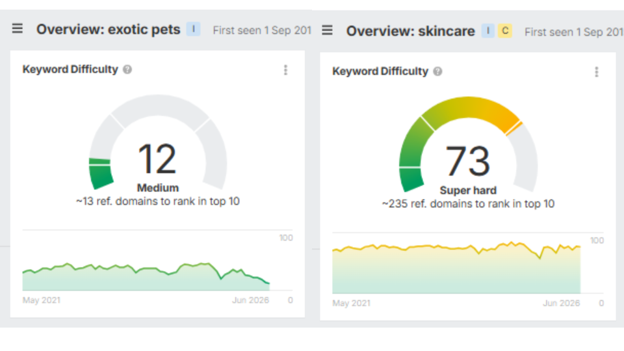
Competition varies by niche. Which is why your niche should be treated as a critical element when building backlinks. The more competitive a niche is, the higher the number of backlinks may be required to outrank top pages.
Here’s an example. “Exotic pets” is a micro-niche keyword with low competition. The top-ranking pages for this term have a maximum of 296 backlinks, which means that if this is your target niche, you’ll likely have to create fewer backlinks.
However, “skincare” is a broader term belonging to a highly competitive industry. For this term, the top-ranking pages come down to a maximum of 1,929,446 backlinks. That’s a huge number to compete with if you’re targeting the skincare niche.
Important! Note that for a broad head term like ‘skincare,’ raw backlink totals can be misleading, as large brands often have years of accumulated links, homepage authority, and brand demand behind them. However, it may still give you an idea about your existing competition.
To put it simply, your website niche determines what type of keywords you’d have to compete for, and that also has a lot to do with your backlink benchmark in SEO.
The Target Page
So when we look at page-level factors for backlinks, there are multiple things to consider. For example:
- Page Authority: A high page authority indicates a higher likelihood of ranking for your pages. But how can you improve this number? By maintaining a strong backlink profile, having powerful referring domains, and optimizing content.
- Page Type: Is it a power page or a subpage? Content-heavy pages that answer real user queries and offer unique value are much more likely to earn more backlinks naturally. Whereas a thin content page that’s part of a cluster having too many backlinks might look suspicious to the Google algorithm.
- Focus Keyword: What is the difficulty and competition for the keyword you’re targeting on that page? This is important because a low-competition keyword is inherently easier to rank for.
💡Bonus Point: One more thing that’s crucial to note here is that to rank a single page, you need backlinks not just on that particular page but on supporting pages as well. That includes the home page, category pages, and internally linked pages. This technique ensures that link equity flows naturally through internal pages to the target page, reinforcing its ability to rank.
Your Current Backlink Profile
Now on to the next one, your current backlink profile. That doesn’t just mean how many backlinks your website currently has; it also factors in a site’s referring domain (primarily their DA), relevance, and anchor text.
Backlink Profile
A key factor reflecting the strength of your backlink profile is your DA (Domain Authority) or DR (Domain Rating) score. This score is evaluated based on the quality and quantity of backlinks on a website, as well as its linking root domains. The higher this score is, the more primed a website is to compete against established players in their industry.
Now we all know how to estimate the quantity, but how does quality factor into the equation? It is based on your referring domains. If backlinks come from authoritative sites and are linked out to pages that are relevant to the niche, it counts as a vote in favor of your backlink profile.
Here’s an example. In the search optimization niche, a backlink from highly credible websites like SEJ and Search Engine Land has greater value than a random low-DR site in the same niche.
Anchor Text
A lot of brands hyper-focus on keywords when optimizing anchor text. That’s a mistake.
An anchor text should provide a clear indication of what the page is about. It should be contextual and set clear expectations for the reader about where the link leads.
Google’s guidelines for anchor text are clear.
“Good anchor text is descriptive, reasonably concise, and relevant to the page that it’s on and to the page it links to.”
A safer practice is to keep anchors natural and context-led: brand anchors, URL anchors, partial-match anchors, and descriptive anchors should all appear where they make sense editorially
Internal Linking
Cross-referencing your own content doesn’t just help crawlers explore your content; it’s also critical when trying to maintain a healthy backlink profile. Internally linking through relevant topic clusters helps pass link juice to the lower-funnel pages, boosting their individual page authority.
This way, the number of backlinks you’ll need to rank a page may also be reduced. For example, a page with a PA of 20 is linked to a page with 89 PA. The equity flows across the higher authority page to the lower authority page, anchoring it better against competition.
A strong internal linking structure can reduce reliance on direct backlinks by helping important pages inherit authority from related pages. Google emphasizes two main factors for internal linking: contextual placement and relevant anchors. According to their guidelines:
“Every page you care about should have a link from at least one other page on your site.”
Content Quality & Relevance
And lastly, optimize your content to attract more organic backlinks. In general, it should be authoritative, answer the query efficiently, and be genuinely helpful for searchers. Quality content combined with contextual internal linking is the power combo that can boost any website’s ranking potential.
Industry-Wise Backlink Requirements
A study by WebFX gave us some measurable results to gauge the generic backlink numbers required to compete in each industry. They analyzed various niches and provided a broad verdict regarding the referring domains needed in specific industries.
These are the key stats from the study.
- While the overall median number of referring domains for page-one rankings sit at 907 across 15 industries, the actual range tells a more nuanced story, spanning from just 76 in Apparel all the way to 3,027 in Finance & Insurance.
- Some sectors are far more accessible than others. Six industries require fewer than 500 median referring domains to rank on page one: Apparel (76), Arts & Entertainment (173), Dining & Nightlife (235), Food & Drink (284), Beauty & Personal Care (361), and Home & Garden (461).
- Beyond quantity, link type plays a critical role. Across all 15 industries, 92.2% of backlinks pointing to top-ranking sites are editorial links, while directory links account for 6.8% and resource links just 1.1%. This provides a clear signal that earning authoritative links outweighs simply accumulating them.
- The average link velocity across all industries is 48 new referring domains per month, with Finance & Insurance leading the pack at 101 new referring domains per month. Consistent link acquisition, not just total volume, is what sustains rankings over time.
These benchmarks help set expectations, but your actual link gap depends on the current SERP, the specific URL type, content quality, search intent, internal linking, and the strength of competing domains. Once you know the size of your link gap, our link building services can turn that benchmark into a structured acquisition plan built around relevance, authority, and sustainable link velocity.
Is it possible to measure the exact backlinks you need to rank?
Yes, it’s possible to estimate exactly how many backlinks are needed to rank on page 1 for a specific keyword. The LBHQ Backlink Estimator does all the back-end calibrations and audits needed to give you a practical link-gap estimate based on current SERP conditions.
How do we do this? We check your current position for the given keyword, analyze all domains ranking above it, find an average of their backlink value, and then apply our own internal calibrations to give you a clear estimate.