
May Core Update 2026 – Everything You Need To Know
On this page
Skip the reading — get a live diagnosis.
Book a callGoogle’s May core update 2026 rolled out from May 21st to June 2nd, an event extending 12 days that reshuffled the SERPs across news, ecommerce, finance, and health.
And this one was bigger and more disruptive than March’s update, handing sharp gains and steep losses to various sites. Here’s what happened, who won, who lost, and what it means for your SEO.
The Volatility
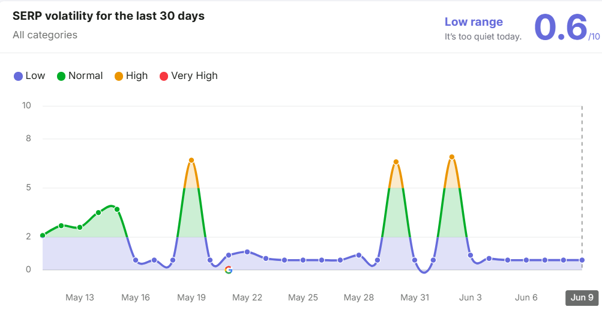
Surrounded by the overall calm, the update did experience some peaks here and there. The prominent peaks were seen around May 30th and then again between June 1st-2nd.
Barry Schwartz described the May 30 weekend specifically as “super volatile,” calling this overall “a pretty significant Google core update.”
Note that volatility does not always mean that sites were penalized. During a core update, Google is reassessing how well different pages and source types match searcher intent. A drop may reflect source-fit changes, not necessarily a technical issue or manual action.
May Core Update Impact Across The Board
The team at Link Building HQ performed a comprehensive review of the trends and patterns happening through the update, compared pre- and post-update data points, and examined numerous industries to find out the notable impact of this update.
Review our notes on the May core update impact below.
Industry-Wise Impact
Each industry was evaluated on a few basic factors: their traffic trends, keyword rankings, and domain authority to assess what went down over the course of this update and how each industry was affected.
Thin Aggregator Sites Took A Hit
Through our research, we received multiple reports of aggregator sites being impacted during this update season. Aggregator sites are platforms that collect and display content, products, listings, or information from multiple third-party sources in one place, rather than creating most of the content themselves.
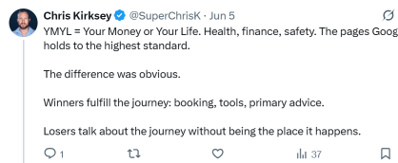
This includes news aggregators, shopping comparison websites, and job listing platforms. Chris Kriskey noted in his analysis of 48+ YMYL sites that: “Thin aggregators dropped 60%,” an impact that is relatively huge.
Studying Ahrefs data, we found that many sites experienced a traffic spike before entering a period of decline during the rollout.
From the aggregator sites we tested, here are our findings:
- AllSites got hit on 19 May, recovered for a while, then again declined on 7 June.
- Shopping.com experienced diminishing traffic after June 2.
- Simply Hired started dropping on 4th June but regained composure around mid-month.
- Product Hunt got hit on 27th May.
YMYL Sites had inconsistent movement
Moving on to the YMYL sites, the finance niche experienced the highest fluctuations. As we analyzed more and more sites, we were able to make a clear distinction between gains and losses; winners were fulfilling the customer journey from initial click to sign-ups and bookings, while losers seemed to have the content but failed to hit all customer journey touchpoints.
Some of the YMYL sites we evaluated exhibited surges and drops throughout the rollout.
- CNN Business News – Saw sharp hikes post-update
- The Motley Fool — Dropped slightly after June 1
- Market Watch — Dipped after May 21
Medical Websites
Medical sites didn’t experience sharp drops, but the patterns seemingly pointed to the same thing: consistent authority pays off. It was interesting to see that many credible players in the industry, despite maintaining a strong footing for years, saw a measurable impact this update season.
Medical News Today experienced a traffic loss after winning big in the March Core Update. Their traffic trend seemed to be declining despite no decline in organic pages.
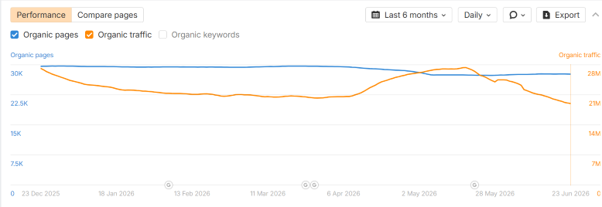
Meanwhile NHS.UK and WebMD maintained stable traffic and rankings throughout the rollout period. Whereas Healthline.com and GoodRx also experienced a traffic loss following the beginning of the rollout.
In the previous update, it was seen that visibility consolidated toward a certain group of health brands, particularly those meeting the following criteria: having better authority, improved topical depth, and content backed by a team of professionals. However, with the recent update, it seems like Google has recalibrated which source destination it prefers for different query types.
So, the broader takeaway can be, while at its core, the idea that trust and authority matter remains intact, matching users’ expectations and query intent better than your competitors still determines whether a brand will win in this rollout season. What we can safely say is that Google may be refining which source type best satisfies each query: publisher, medical institution, government source, research body, commercial health platform, or forum-style experience.
Reddit Is Doing Better Than Ever
Reddit claimed the biggest win this update season, and it was even bigger than what was reported after the March core update.
According to SE Ranking’s analysis, Reddit’s share of top-3 positions rose to 10.24% after May, and this trend is consistent across all 20 niches they tracked.
Reddit also won the #1 spot far more often, with the number of keywords for which it carries first position rising 54% compared to March. That clearly indicates a bigger boost in comparison to the previous update.
Some Reddit niches saw bigger gains than others. Here’s who won and who lost.
- Biggest gains were noted in niches where people are actively looking for real opinions and firsthand experiences, like Pets, Education, Sports, and E-commerce.
- Reddit rankings barely moved for the YMYL sites like Real Estate, Healthcare, and News, which inherently carry a higher expectation of accuracy and credibility.
It’s important to point out Aleyda Solis’s findings here, which notably mentioned that forums pulled back on aggregate visibility. In her analysis, she states.
“The pullback in forum, Q&A and open-publishing surfaces was clear: aggregated -24% in the UK and -12% in the US. Reddit, Quora and StackExchange all declined in both markets. Reddit’s percentage drop was smaller than some others…”
So what does this tell us? Reddit specifically kept growing in low-stakes, experience-driven niches even as forums as a category lost ground in YMYL-adjacent search results.
March Vs May Core Update Comparison
Analyzing consecutive updates helps pinpoint which factors are increasingly becoming critical in the search landscape. So we dived into numerous studies and resources to find out the correlation between the two updates. Comparison of ground-level factors helped identify which sites are increasingly getting favored in the ranking assembly.
Here’s what we found.
- Reddit held the first position for 54% more keywords than in the March update.
- The top 3 positions on the SERPs saw more unique domains in May, whereas unique domains for the top 10 positions rose by 2.05%
- A third of the domains that dropped after March returned to the TOP 10, and new domains also entered the mix.
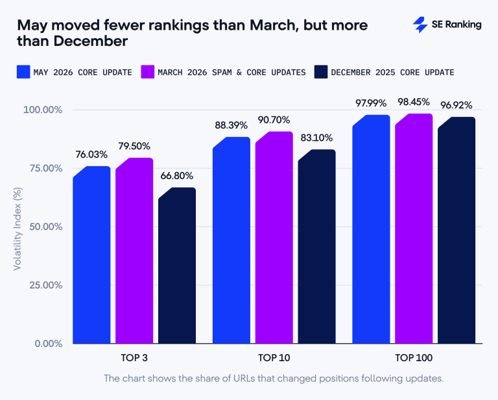
- Compared to March 2026, which pushed visibility away from directories, aggregators, and quick-answer content toward stronger destination sites, the May core update refined which type of destination Google favors for each specific intent and market.
- Category-defining jobs and travel marketplaces that lost visibility in March bounced back in May.
- Few previously stable authority sites lost ground in May, especially those that weren’t the best-fit source type for the query’s dominant intent.
- May introduced a stronger localization signal, notably benefiting local e-commerce entities in the UK market.
Here are the May 2026 movements compared across the previous two broad core updates in March 2026 and December 2025.
A Peek Into The Expert Observations
Let’s have a look at what SEOs, site owners, and webmasters observed during this core update to get a more expansive view of the update and its impact.
Glenn Gabe’s Notes
Glenn Gabe came up with some notable insights on the update. In his early observation, he reported some visible movements in the sites spamming for AI Search visibility. In addition, he also reported medical sites experiencing some big swings, too.
And the impact further grew strong after the update landed over the weekend. In another tweet, he noted that e-commerce retailers experienced some major movements, whereas sites in gaming, reference, recipes, news, lyrics, and finance also saw noticeable fluctuations.
He further mentions that the emerging developments and patterns from May Core Update refer to the fact that this was a typical core update, unlike the last update we got in March.
Community Reactions
Just like with every update, reactions to this core update rollout remain divided within the community. Some people reported gains and recoveries, and others reported major traffic and visibility losses.
Here is what various site owners have experienced during and after the rollout period.
“Still holding strong. Usually would see more movement towards the end.” – Twitter
“Stable for a few sites.
One website got beaten up pretty badly, still not able to understand the issue.
All the content is human written content.” – Twitter
“Core update: that explains the sharp drop yesterday: again 50%.” – Webmaster World
“Core updates from Google continue to punish commodity content. Non-commodity blogs with real expertise and unique angles are the ones holding the rankings.” – Reddit
There were also multiple reports of lost impressions and clicks overnight. From getting thousands of impressions each day, some sites slid down rapidly and lost up to half those impressions.
The interesting thing is that most of these website pages are indexed and ranking, so the dramatic decline in their impressions can’t be attributed to a technical issue or a manual action. It seems that Google simply decided to deprioritize them, even though they remained indexed and eligible to rank.
“Before the update, I was consistently getting 6,000+ impressions per day in Google Search Console. Since the update rolled out, my impressions have dropped dramatically and are now hovering between 600-900 per day.” – Reddit
“I am in the same boat. I used to get around 75000 impressions and more than 1000 clicks., now it is down to a trickle with over 5000 impressions and 60 to 70 clicks.. Avg ranking has been down, CTR has been surprising stronger (increased by 50%). Afte analysisng I realied that all my pages are indexed and ranked. the ranking for each page when they do appear is almost the same but the impressions that each page gets is down dramatically.. google isnt showing my page frequently. This is close of organic search as I know for my website. It was all dramatic, mid night traffic and impresions dropped suddenly and have been there for a week” – Reddit
What to Do If You Were Hit
If your traffic dropped during this rollout, a few practical steps are worth taking before making any drastic changes:
-
Wait a full week past rollout completion
Don’t scramble to fix things right away. Wait until after June 9th to begin drawing firm conclusions or running audits. Why? Because rankings keep shifting in the days right after a core update finishes. The best time to measure change in rankings, traffic, and impressions is a week after the rollout ends.
-
Monitor Search Console
Keep an eye on how things are moving pre- and post-update on your GSC dashboard, but don’t forget to factor in seasonal or update-unrelated trends into the equation.
You can segment GSC data using this template.
- Compare May 14 to 20 vs June 9 to 15 in GSC
- Segment by page type: blog, product, category, tool, forum, aggregator, author page
- Segment by query intent: informational, commercial, transactional, local, YMYL
- Identify winning and losing pages
- Compare lost pages against the current top-ranking source types
- Look for content gaps: freshness, expert review, original data, user journey, next step
- Check technical causes: indexing, canonicals, template changes, page speed, crawlability
- Review internal linking to declining pages
- Review backlink profile and anchor mix, but don’t assume links caused the drop
- Prioritize updates where the page no longer matches the dominant intent
-
Analyze the extent of the change.
A gradual decline over weeks tends to point to a content-quality or relevance issue; a sharp, sudden drop lines up more with a pure algorithmic re-sort, where your content may simply no longer be the best fit for the intent Google now favors for that industry or query.
-
Assess pages for the user journey
Check if the affected declining pages offer a complete user journey or clearly point toward the next part of the journey. The data across Kriskey’s study, Aleyda Solis’s source-fit analysis, and our own aggregator examples all converge on the same answer: pages that fully resolve the searcher’s need outperformed pages that merely aggregated or pointed elsewhere.
Takeaway
Safe to say that the May Core Update 2026 was a quick affair, landed quickly after the announcement, and brought us some major gains and unprecedented drops. Moreover, there were several movements noted across different verticals like healthcare, news, forums, and more. All these developments represent how powerful and interesting core updates can be.
It feels like more of an algorithmic recalibration introduced to restructure how Google sorts the SERPs and which source destination it prefers for each query intent and market.
Sites with editorial depth, better topical authority, and better search-result fit were rewarded. This indicates that to survive the core update season, relevance won’t do it alone; you need to match what users expect from the top results and do it better than competitors
A huge thanks to the people who share their experiences online, and appreciation for SEOs sharing regular updates and assessments. We wouldn’t know all that we know without your help.
You Know How It Works. Let Us Run It.
Book a call with a strategist or check out our services to find the best fit for you.

Written by LBHQ Editorial Team
Strategists and outreach leads who've shipped 4,000+ links and recovered dozens of penalized domains.