AI engines mention brands that appear frequently across high-quality, independent sources like reviews, press coverage, and industry publications. They ignore brands that lack that digital footprint or are positioned too vaguely for the AI to associate them with a specific problem. The answer to how to get mentioned in AI answers is simple: if the internet talks about you clearly and often, the AI will too. If you’re not showing up in LLM answers, take solace in the fact that there is some order to the chaos. There’s a reason why some brands are mentioned, and others aren’t, and that’s exactly what we’ll get into in this blog.
We’ll explore the best AI SEO strategies, how ChatGPT, Perplexity, and Gemini choose their answers, and what makes content optimized for AI search engines. Let’s help you figure out how to get mentioned in AI answers.
What’s the Difference Between AI Citations and AI Mentions?
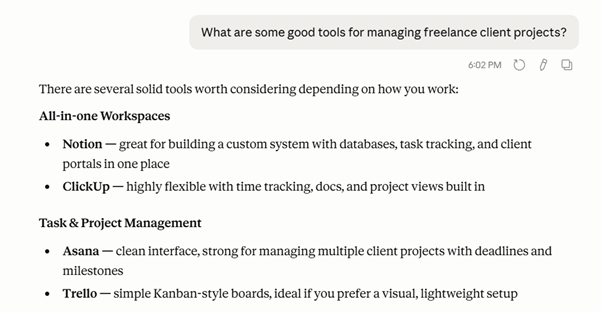
An AI mention is when an AI tool simply names your brand in a response — “tools like Notion, Asana, and Trello are popular options.” Your brand appears, but without context or endorsement. It’s visibility, but passive.
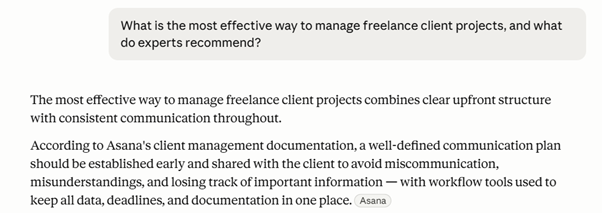
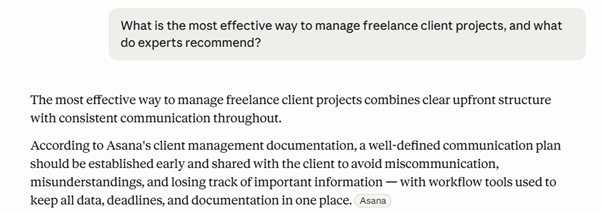
An AI citation is when the AI goes one step further by not only naming your brand but also referencing specific content from your website, a published article, or a third-party source to support its answer. Perplexity, for example, actively cites URLs because your content was deemed credible enough to be used as evidence.
AI Mentions help you increase awareness, whereas AI citations build authority. If your goal is to become the default recommendation by LLMs, citations should be the priority because they’re proof that your content is trusted, structured, and authoritative enough to be backed up by AI.
Also read: What is brand mention link building?
Do Brand Mentions Outweigh Backlinks for AI Visibility?
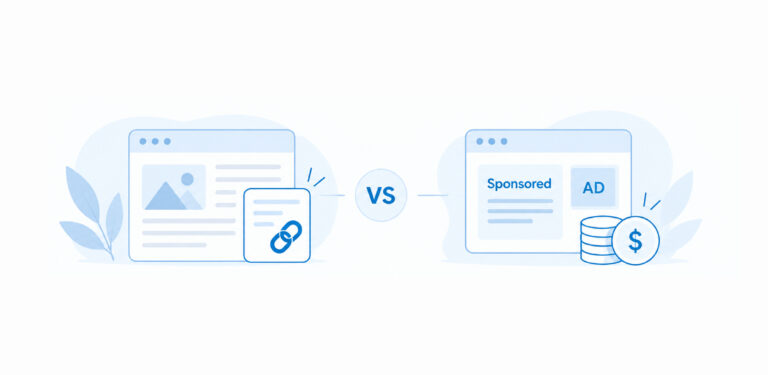
Short answer, yes. But a more nuanced approach shows that it’s not really about brand mentions vs. backlinks, because they serve distinct roles in how AI systems discover and evaluate your brand.
Backlinks remain integral to retrieval because your content needs to rank in the first place. Mentions, on the other hand, help AI systems understand who you are, what you do, and whether you’re trusted across the web. AI tools appear to rely heavily on consistent mentions across multiple independent sources to form a reliable picture of your brand.
Mentions improve whether your brand gets selected in an AI answer, while backlinks improve whether your content gets found at all. Remove either variable, and your AI visibility takes a hit.
How to Bridge the Gap Between Citations and Mentions?
- Start with content worth citing. A mention occurs passively, like when someone references your brand in a roundup or review. But a citation requires that you’ve published something authoritative enough to be used as a source, like guides, original research, and frameworks.
- Turn your mentions into citation opportunities. Every time your brand is mentioned on a third-party site, ask: Is there a piece of content on your site that could be linked or referenced alongside that mention? If not, create it. The goal is to give AI systems a direct line from “this brand exists” to “here is proof of what they know.”
- Build topical depth, not just breadth. AI tools are more likely to cite a source that covers a topic comprehensively. A brand with ten deeply researched articles on one subject is more citable than a brand with a hundred shallow posts across many topics.
Why AI Engines Remember Some Brands and Forget Others
1. Depends on the Data AI has Trained On
Large language models are trained on enormous slices of the internet. The more a brand appears across diverse, high-quality sources, the more “familiar” that brand becomes to the model. Sources included news articles, review sites, forums, industry publications, Wikipedia, and academic papers. A company that’s been written about in TechCrunch, cited in Reddit threads, reviewed on G2, and discussed in LinkedIn articles is more likely to be absorbed by the models during training.
2. If Your Positioning is Consistent Throughout
AI engines are also pattern-recognition machines. If every mention of your brand across the web ties it to a specific problem like “the best tool for solopreneurs managing client invoices”, it trains the model to associate you with that exact use case. When someone asks about that use case, your name surfaces.
Brands that get ignored are often those that haven’t made a clear claim. They’re described differently in every article, positioned vaguely on their own website, and associated with a broad range of use cases without owning any. To an AI, those brands look blurry.
The lesson: Pick a lane. Be known for one thing so clearly that any sufficiently-trained model can complete the sentence: “For [specific problem], [your brand] is the go-to because…”
3. If You Publish Structured, Citable Content
Long, well-organized articles with clear headings, factual claims, and definitive statements are far more likely to be absorbed and cited than vague, hedged, or poorly structured writing.
Content optimized for AI search engines isn’t just content stuffed with keywords. This looks like definition paragraphs, comparison tables, numbered processes, and direct answers to specific questions.
How ChatGPT Chooses Answers (And What That Means for You)
How ChatGPT chooses answers isn’t a published algorithm, but there has been some speculation that it draws from several overlapping sources of signal:
- Frequency across sources: How many independent places mention your brand in a relevant context?
- The authority of the source: A mention in Harvard Business Review carries more weight than a mention on a low-traffic blog.
- How recent it is (for retrieval-augmented systems): For AI tools that browse the web, fresher content gets prioritized.
- Sentiment and framing: Brands consistently described in positive, expert contexts get associated with quality.
- Specificity: Vague descriptions (“a software company that helps businesses”) train the model to say nothing specific. Specific descriptions (“a no-code CRM built for independent consultants”) train it to say something useful.
ChatGPT and similar tools are looking for the collective consensus on the web about a topic. If the collective consensus doesn’t include your brand, you’re not going to be the answer.
Also read: AI Visibility Tracking: The Whys and Hows
What Actually Gets You Cited
Here are the dos and don’ts of getting cited by LLMs and boosting visibility.
Building Third-Party Mentions at Scale
It doesn’t matter what you say about your brand if other people aren’t talking about it, too. AI models weigh third-party signals heavily. That means:
- Getting reviewed on G2, Capterra, Trustpilot, and industry-specific platforms
- Earning press coverage in publications that your target audience reads
- Being included in “best of” listicles and comparison articles — even if you’re not #1
- Getting featured in podcasts, YouTube videos, and interviews that get transcribed online
Creating Content That Directly Answers Questions
The backbone of any AI SEO strategy is building content that matches specific query intent. Think about the exact questions your ideal customer asks, then build content that answers them precisely and authoritatively.
Make product features more specific to your target audience, for example, “How to Manage Client Invoices as a Freelancer in 2025.” This elevates your standard SEO blog post to something that helps an AI system learn what your brand knows and who it helps.
Owning Your Subcategory
The brands that dominate brand mentions in AI tools almost always own a specific niche, which makes brand recall easier. Zoom owns “video calls.” Canva owns “easy graphic design.” Notion is an “all-in-one workspace.” None of them is described as a technology company.
If you’re trying to rank in AI search, the fastest path is to become the definitive name for a narrowly defined thing. The more specific the niche, the less competition there is, and the easier it is for an AI to learn the association.
Updating Your Content Regularly
AI tools with real-time browsing capabilities, like Perplexity and ChatGPT, prioritize fresh signals to provide the most relevant responses. A blog post from 2019 carries less weight than one published last month. Keep publishing content to make your brand active on the retrievable web.
Being Consistent Across Every Touchpoint
Your brand should be described identically whether someone encounters it on LinkedIn, in a press release, on your homepage, or in a guest post. Inconsistency just makes more noise in your space, but the more consistently you describe your value proposition in the same words and framing across the web, the more clearly an AI model learns what you actually do.
Read more: How to do a content refresh for AI
TL: DR; How to Get Mentioned in AI Answers
Step 1 — Be precise about your position.
Know who you help, how you help, and what makes you different. Write it in one sentence. Use that sentence everywhere.
Step 2 — Generate authoritative third-party mentions.
Example: Reviews, press coverage, expert roundups, and podcast appearances.
Step 3 — Publish structured content that answers questions people ask about your brand.
Example: Blog posts, guides, and comparison pages that directly address what your audience searches for.
Step 4 — Build a consistent digital footprint.
Example: Your brand description should be consistent across your website, social profiles, directory listings, and any press mentions.
Step 5 — Monitor what AI tools say about you.
Example: Regularly ask ChatGPT, Perplexity, and Gemini questions that your customers would ask. See if you appear. If you don’t, identify which competitors do and reverse-engineer their footprint.
The Brands That Will Win the AI Era
The companies that figure out how to get mentioned in AI answers early will hold a significant advantage as AI-assisted search becomes the default way people discover products and services.
Getting there is just hitting the right mix of positioning clarity, content discipline, and earned credibility, pretty much the same things that have always separated recognized brands from forgotten ones.