
Google’s First-Ever AI Optimization Guidelines Blog
On this page
Skip the reading — get a live diagnosis.
Book a callAll these years, we were playing by assumed rules, but not anymore. Google has released its first-ever AI optimization guide, and we’re here to break down exactly what they officially laid out.
Why AI Optimization Matters for Google?
As the user behavior evolves, so does the Google algorithm. And while many waited for an official announcement from Google about which strategies are most effective for boosting visibility in generative AI, much of the industry relied on assumptions and early experimentation.
Knowing which factors influence AI search visibility on Google’s AI search features is critical to maintain visibility and clicks. Here’s why it’s important to optimize for AI in the new search era:
- According to 2026 data, 64.82% of Google searches end without a click, meaning searchers get quick answers directly from Google’s AI search features rather than clicking through to websites.
- AI search experiences offer an opportunity to engage relevant audience and reach people with a stronger conversion potential.
- AI-driven SERP features, such as AI Overviews and AI Mode, divert user attention away from traditional search results.
Two AI Retrieval Techniques Google Actively Uses
In its AI optimization guide, Google explains which techniques the system implements to retrieve information for AI search features. This isn’t just a source reference but a clear indication of which strategies can, inadvertently, affect visibility for generative AI engines.
Retrieval-Augmented Generation (RAG):
AI systems use web sources for live information retrieval when the training data runs thin. For that, it uses a framework called RAG to efficiently access and present information available on the internet. AWS defines RAG as,
“Retrieval-Augmented Generation (RAG) is the process of optimizing the output of a large language model, so it references an authoritative knowledge base outside of its training data sources before generating a response.”
RAG retrieves information in three phases:
- The system uses advanced search algorithms to explore data from websites, PDFs, and databases.
- The collected information is pre-processed: converted into tokens, stemming applied, and reviewed to remove unnecessary words.
- The processed information is integrated into pre-trained LLM data to seamlessly deliver context and comprehension.
Google uses RAG to retrieve up-to-date information from its search index. It then cites the pages to show users where the information was extracted from.
Query Fan-Out:
The query fan-out technique was introduced to answer prompt-style questions. This is tied with SEO principles, as it compiles information from multiple relevant queries into one single answer. For example, if you ask “how to get rid of acne,” the system will retrieve information from fanout queries like,
- Best natural remedies for acne
- Foods that help clear skin
- Skincare routine for acne-prone skin
- Best ingredients for reducing acne scars
- Can stress cause acne breakouts?
All these are related queries likely to contain parts of the information the searcher is looking for. Thus, a combined answer is created using the query fanout technique. For more information on this, review our blog about AI Mode & query fan-out.
The Common GEO Myths: What everyone thought works but doesn’t
Lo and behold, all those webmasters making empty claims about AEO/GEO have been exposed. With Google officially dissolving some of the most popular tactics in the supposed “AEO/GEO experts” playbook, it became clear we still have a lot to learn about AI optimization. But assuming these tactics don’t work for other LLMs like ChatGPT or Claude isn’t something to swear by.
Here’s what they claimed is unlikely to make any difference to AI search visibility.
LLMs.txt or AI markup files
Google bots can index and read multiple file types, including .html, .xml, .csv, and images, so its AI features don’t need special machine-readable text files or markdown to understand the context of a page. The article also clarified that the system doesn’t treat an llms.txt file any differently. They further added:
“For Google Search, you can ignore tactics like “chunking” content, creating unnecessary AI text files (like llms.txt), or pursuing inauthentic mentions.”
Content chunking or rewriting
Chunking content into shorter, digestible pieces so AI can understand it better turned out to be a myth. Google’s systems are fully capable of processing both short and long paragraphs for context. Similarly, content doesn’t need to contain specific long-tail keywords for AI systems to understand its meaning. The doc specifies this clearly, saying:
“You don’t need to write in a specific way just for generative AI search.”
Mentions that aren’t organically obtained
Brand mentions obtained through inauthentic means are unlikely to deliver real value in terms of AI visibility. Google’s generative AI features can easily parse sources across the web to analyze what’s being said about products and services. But if mentions are purchased, exchanged, or obtained via automated schemes, they’re unlikely to create a positive impact on a brand’s AI visibility.
Structured data
No rule in the AI optimization rulebook dictates that schema markup is mandatory for generative AI search visibility. And that’s exactly what the document also confirmed. While structured data remains an important part of SEO for businesses wanting to appear in rich results, generative AI tools don’t particularly rely on it.
Note: Structured data may not be required for AI visibility specifically, but it still helps search engines interpret entities, relationships, products, reviews, and business information more reliably.
Traditional SEO Principles Still Apply to AI Search
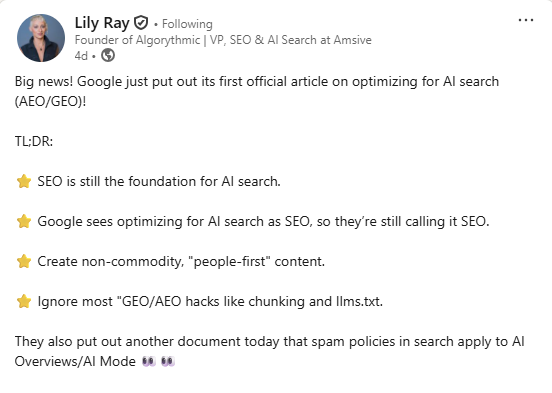
One of the biggest takeaways from the document was that traditional SEO remains highly relevant, even in the era of AI-powered search experiences. Apparently, most SEO principles also help make a website more relevant for AI search features.
Lily Ray’s takeaway summary of Google’s AI optimization guidelines blog neatly puts this into perspective.
Let’s summarize traditional SEO practices that stay relevant to date.
Content Optimization Practices that still work
Content remains at the heart of both SEO and GEO strategies. Surprisingly, many of the most effective content optimization practices still overlap across both approaches. The fundamentals of creating valuable, relevant, and well-structured content continue to drive visibility, engagement, and search performance. Here’s what’s likely to contribute to your AI search visibility on Google.
- Adding a unique point of view to a topic rather than recycling existing content. AI systems analyze multiple pages at the same time, so when a unique take or a personal experience is presented, it’s more likely to get featured in the answer.
- Create content for your audience, not search engines, using Google’s guidelines for helpful, reliable, and people-first content. This approach excludes generic commodity content built around topics offering no unique value.
- Follow a clear content structure, with appropriate headings, paragraphs, and other content sections, so it’s easier for readers to skim through.
- Integrate diverse content formats into the page, including headings and videos, and use appropriate optimization techniques for these files. Refer to the image and video best practices document for more. Since AI search features integrate both videos and images while answering questions, adding them can boost the overall chance of getting referenced.
- Focus on creating content that genuinely helps users instead of producing endless pages just to manipulate rankings. Google’s AI can now understand content relevance beyond exact keyword matches, making content quality and usefulness far more important than its volume.
- Scaled content using generative AI tools is demotivated if it violates the search standards or borders on spam. Make sure to follow AI-generated content guidelines when leveraging automation.
Technical SEO guidelines are still relevant
Meeting every content requirement still doesn’t guarantee AI will crawl, index, or surface your content. For that reason, technical SEO optimization for AI is critical. Here’s what Google deems critical when optimizing for its AI features, like AIOs, AI Mode, and Gemini.
- Make sure all important pages are indexable and not blocked by robots.txt. But that’s not it; the content on a page should also be in an indexable and accessible format, inclusive of all text, images, and videos.
- Ensure content is crawlable so AI can access, crawl, and cite it. Here’s a simple rule of thumb: If Google can’t read it, its generative AI search features can’t learn from it. Large or frequently updated sites especially need to take crawl budget seriously.
- Avoid overthinking semantic HTML into paralysis. Google can read invalid HTML, so your code doesn’t have to be perfect, but it’s best to have a clean, readable structure that naturally benefits screen readers and Google alike.
- If your site runs on a JavaScript framework, crawling, rendering, and indexing may become more complex. While the system is perfectly capable of processing JS, there’s almost always more room for things to go wrong in this framework. Follow JavaScript SEO best practices to make sure traffic doesn’t stall.
- A good page experience is more important than you think. When pages are device-compatible and dwell time is higher, it indicates to AI engines that a website is trustworthy.
- Eliminate duplicate content; it might be quietly bleeding your crawl budget and diluting ranking signals.
Local optimization for local businesses
Google’s guidance extends to local businesses as well. According to a Whitespark survey, 57% of local queries include an AI overview.
When businesses compete for merchant listings and local packs, it’s also important to contend for visibility in the AI-led features like Ask Maps and AI summaries.
Here are the local SEO factors businesses should prioritize for improved visibility in generative AI features:
- Optimize your Google Business profile to make products and services eligible for AI-generated features on local services.
- Get featured in local directories and listing pages.
- Build location-specific pages for all target regions to ensure consistent visibility.
- Publish geotagged photos to your business profile and reply to reviews to highlight strong engagement.
Role of AI Agents
Google AI optimization guide notably references agentic AI, pointing toward a more automated search experience. In fact, Google’s CEO, Sundar Pichai, recently stated: “It’s clear we’re firmly in our agentic Gemini era.” This establishes that the search giant is headed into a futuristic model likely to be operated by AI agents. Our theory is that an agent-friendly website might be the next standard for AI search visibility. More on this here.
Next Steps:
Google’s first-ever take on AI search optimization wasn’t short of surprises, but it’s safe to say all those “SEO is dead” claims have been busted. That said, SEO factors still remain relevant for AI-generated search features, and any brands looking to boost visibility should focus their efforts on an integrated strategy blending search evolution with key traditional practices.
In the end, helpful content, a good UX, and a good reputation remain at the core of what a brand needs to get cited, referenced, or mentioned in the AI-generated search features.
You Know How It Works. Let Us Run It.
Book a call with a strategist or check out our services to find the best fit for you.

Written by LBHQ Editorial Team
Strategists and outreach leads who've shipped 4,000+ links and recovered dozens of penalized domains.