Brand mention and link building are terms often used interchangeably. Why? Because branded mentions can be turned into high-quality backlinks to establish authority and boost a website’s SEO. Nearly 90% of SEOs believe they also influence organic search rankings.
To dig into this topic further, we’ve created this guide to help you understand:
- What is brand mention link building?
- How to track branded mentions?
- Ways to leverage brand mentions for a stronger backlink profile.
So, without further ado, let’s get started!
What are Brand Mentions?
A brand mention is earned when an online source refers to your brand, directly or indirectly. In other words, if the name of a brand, its products, or services are talked about in any context within the online spaces, it qualifies as a brand mention.
Surprisingly enough, it’s also a sign of contextual relevance for Google, helping establish credibility and visibility across the search engine. Just like backlinks work as votes of confidence, unlinked brand mentions work as word of mouth. And they can come from any online channel, including social media, forums, blog posts, partnerships, and quoted statements, besides other things like;
- Product reviews or testimonials
- Brand slogans & logos
- Copyrighted images
- Event collaborations or those hosted by your brand.
That said, there are three different types of mentions: direct mentions, indirect mentions and implied mentions.
Direct mentions
Direct mentions are the low-hanging fruit. This is when a referee outright mentions your name or product, which makes them easiest to reclaim brand citations from.
A good example of it is this article on The Wall Street Journal, mentioning both the product and the manufacturer’s name in the title.

Indirect mentions
On the other hand, indirect mentions don’t directly mention a brand or product name, but carry an underlying intent to refer to it. Here’s an example:
“That swoosh company just dropped some new kicks.”
Swoosh is a clear reference to Nike’s logo, suggesting the brand was alluded to rather than directly named. Although these types of mentions are valuable for brand awareness, they hold little SEO value unless the search engine can clearly disambiguate the entity.
Implied Mentions:
These refer to the most subtle kind of mention of your brand, mostly with a related phrase or keyword, but no direct hyperlink.
Brand Mention & Link Building: The Connection
As the search landscape continues to evolve, user behaviors are shifting at an unprecedented pace. But so are branding and SEO tactics. Today, the search doesn’t rely on PageRank entirely — viewing pages as a web of interconnected links only — it also reads and comprehends other means of branding expressions. Search Engine Land highlighted the importance of brand building in one of its articles recently, stating:
“Stop building links; build your brand.”
Because how people online perceive a brand shapes its reputation and niche expertise, eventually supplementing said brand’s online visibility on search engines. When you’re mentioned in spaces and discussions that revolve around a specific topic, it signals expertise to search bots. That is why brands today are more keen on developing relationships and a powerful industry network than chasing after backlinks.
Despite that, link building remains one of the most powerful building blocks in SEO. So, a combined strategy integrating brand mention and link building could be the perfect propeller to boost your search performance. The two concepts come together to unlock a new term called branded links.
What is a branded link? When a brand mention is accompanied by a hyperlink to the website’s page, it is a branded link. And it sits at the heart of any smart brand-mention link-building strategy. So it’s settled, brand mentions for SEO carry significance, but it’s also important to remember that:
- The source of an unlinked branded mention matters. Just like standard backlinks, a branded mention is best when it comes from a relevant and high-authority domain.
- Algorithm shifts and upgrades can impact rankings, which doesn’t diminish the importance of branded mentions, but might modify their value.
- A linked mention is better than an unlinked mention. The former kills two birds with one stone, giving you a mention and a backlink — the two qualifying factors for brand mention link building.
Benefits of Brand Mention Link Building in SEO
Brand mention link building is a strategy that focuses on converting mentions into backlinks, so they can contribute to a website’s authority. While Google bots continue to crawl billions of pages every day, brand mention link building is designed to transform your existing reputation into search signals these bots can view and render.
But how do brand mentions help boost your SEO and improve your website’s search visibility and traffic? The correlation starts at the foundational level.
Implied Links for Implied Relevance
A Google patent from 2012 described implied links as, “An implied link is a reference to a target resource, e.g., a citation to the target resource, which is included in a source resource but is not an express link to the target resource.”
An express link is one that carries a hyperlink redirecting users to the target domain, but an implied link doesn’t have this component. Despite that, search engines read them as an inherent credibility signal, taking both context and topic into the equation.
In short, whether the link is there or not, the association will eventually be picked up by Google bots. So implied link or express; it can support your journey through search engine rankings.
Sends High Value Signals
Brand mention link building helps associate your brand with key terms and topics you want to be an authority on. To do this efficiently, you must take care of a few factors:
- Track which spaces your brand is getting mentioned or discussed in.
- Ensure mentions come from credible sources and reputed publications.
- Manage associations by prioritizing mentions in niche topics.
Strategic Control of your Link Profile
Brand mention link building puts more control into your hands. It lets you reshape how Google sees and perceives your brand. By determining which mentions get converted into backlinks, you can train bots to put more value on topics and keywords that relate to your niche.
While unlinked brand mentions carry value, linked brand mentions are easier to crawl and track for search engines. It’s most likely they’ll be indexed sooner than the latter as well.
Eventually, combining brand mention and link building helps Google associate your brand profile with relevant topics. This information is used to determine if content matches user intent, and consequently, whether it’s rank-worthy or not.
How To Get More Brand Mentions for Link Building?
Now the big question is, how to optimize your website for brand mention link building, such that those mentions can be counted as votes of confidence? Here’s how.
Turn UGC Content Into Links
Divert focus to what your existing audience is saying about your brand. Brand mentions are most frequently found in user-generated content, which is why they should be among the key factors when approaching branded link building.
Track mentions on platforms like Quora, Reddit, Facebook, Twitter, and other social media channels/forums. Engage with users or build a community around your brand to boost brand visibility and invite direct or linked mentions.
Earn Features in Brand Guides/ Listicles
Structured content is what coffee is for our souls. It’s what Google bots feed on. Or more accurately, “dig.” So when a brand makes it to a top 10 listicle or review, websites should leap at the opportunity of earning a backlink.
The only way to secure brand mentions in this type of content is to work from the ground up. Here is how you can boost your chances of getting featured in niche-relevant listicles, reviews, and roundups.
- Create evergreen content that resonates with your audience.
- Run awareness campaigns, so more people know about your brand.
- Improve the quality of your products and services.
- Create a community rather than just a customer base.
Request A Link from Review & Testimonial Sites
Customer reviews and third-party testimonials can earn you valuable mentions. Besides being the driver for a brand’s success, it’s also a great way to showcase your credibility using backlinks.
Find review and testimonial sites that mention your brand and ask them for a link. This could be a great way to amp up your backlink profile with existing resources.
Leverage Digital PR
Applying digital PR strategies to acquire more brand mentions is a great way to stretch your visibility across various web channels. A whopping 89.6% of PR professionals believe that Digital PR is most effective for building backlinks. And it’s contingent on earning relevant placements across authoritative industry sites, journals, online interviews, guides, and podcasts.
But Digital PR isn’t something you can just grab off the shelf and use; it takes real strategy and effort. This means building long-term relationships, creating link-worthy hooks, and offering expertise in the niche. Follow these gold standards to get the most from your Digital PR strategy.
- Producing irresistible hooks when launching a new product or service.
- Pitching to publications with higher industry value (podcast channels, niche magazines, media outlets, & newsletters).
- Fostering relationships with journalists and editors.
If you want to save yourself the time and PR building effort, opt for a brand mention link building service centered on digital PR to explore a pool of opportunities across online channels.
Track Visual Assets
Your website images and videos work as visual assets that people might refer to and link to. However, in some cases, the image or video is used with the source name only. It’s important to track such mentions and pursue the referring source to add a direct link to your website.
You can find these mentions with manual search via Google Lens. Identify sites using your visual assets without a direct link and request proper attribution.
How to Optimize for Brand Mention Link Building
Reclaiming brand citations is a job meant for the pros. Unless applied strategically, it can be tricky to implement brand mention link building.
If you’re just beginning the process of converting brand mentions into backlinks, there are a few operational principles/steps to follow:
Track Unlinked Mentions
Before you can request link placement, you must first track and extract sources mentioning you. For that, SEOs use a number of tracking tools. These work by browsing the internet to find domains mentioning your brand name, products, or buzzwords to connect referrals to referees.
Among the most popular and effective brand mention monitoring tools, here are a few:
Google Alerts
Google offers a free tool that works around the clock to discover mentions of your company, service, or products online. This tool is great for tracking major mentions, but sometimes may not be as effective as paid tools.
- To start using Google Alerts, add instructions for what you want the system to track. For example: your company name, products, keywords, and taglines.
- Set up alert frequency. Do you want to be notified daily, weekly, or monthly? If you wish to track just PR mentions from news outlets, specify that as well.
- Sift through emails to narrow down reputable and authoritative mentions and work to see if they can turn into valuable backlinks.
Alert Mouse
Alert Mouse is turning into a major competitor for Google Alerts, with many SEOs preferring this due to its precision in exploring new mentions. Here’s Lilly Ray comparing the efficiency of the two:
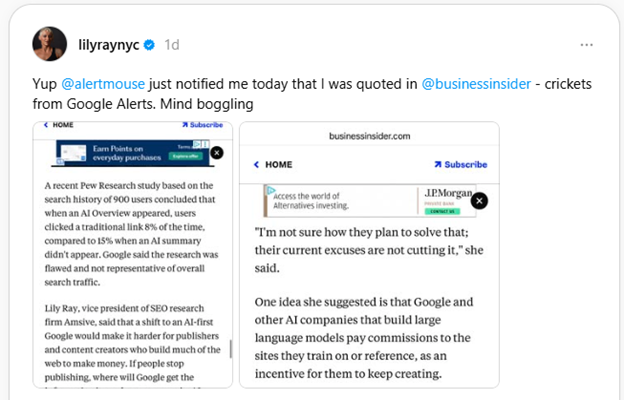
Alert Mouse searches the internet for specific topics besides your brand or company name. It automatically filters out the spammy mentions to give you what really matters: brand mentions from reputed domains.
The email alerts are reserved for important mentions, while hushed mentions are visible on the Alert Mouse dashboard.
Ahrefs
While Ahrefs is primarily a third-party SEO tool with a dedicated backlink tracker, it’s still possible to find unlinked brand mentions on Ahrefs. Here are two methods for that:
Setting up Ahrefs Alerts: Add a new alert in the Alerts tool to get notified when someone mentions your brand. Enter brand name or terms you want to track, select the language, and prioritize based on DR. Add spam domains to the blocked list, ensuring they’re off your alerts list.
Reviewing Mentions on Brand Radar: Search your brand name and any common terms associated with it in the Brand Radar tool. It will show you how many times you’ve been mentioned across the web, as well as in AI answers. You can add filters, analyze performance next to competitors, and review mentions based on topics.
SEMrush
SEMrush is also a broader marketing and SEO toolset, but it also contains a dedicated brand monitoring tool to help track mentions across online channels. Once the brand monitoring tool is set up and filters are applied, it lets you track instances in which your brand is recognized on a website, social platform, or forum.
In addition, its social media tracker helps keep a close eye on who is talking about you on social platforms like Facebook, Instagram, and Twitter. With that, it’s easier to:
- Discover mentions
- Identify opportunities for engagement and outreach
- Build your brand reputation across digital platforms that matter
Prioritize Domains
It’s important to understand that every mention does not justify a backlink claim. Not every domain you’re getting mentioned in is worth your time and effort, which is why it’s essential to prioritize.
As with backlinks, the quality over quantity rule applies here as well. A single mention from a topically relevant, authoritative domain carries far greater value than one with low authority. When setting priorities, keep three key factors in mind:
- Domain authority & credibility
- Niche and industry
- Positive brand signals
Outreach to Claim Links
Once you have a list of reputed mentions, the next step is to reach out to prospects and claim backlinks. Link reclamation can be time-consuming, but it is worth the effort. It lets you tap into backlink opportunities you’d otherwise miss out on.
- Craft a few email templates. While doing that, follow the three-tier rule: simple, upfront, and engaging.
- Start outreach campaigns to target high-value domains, and politely ask for link placement.
- Follow up after a week (or any pre-determined timeline) to ensure the email didn’t go unnoticed. A short and polite follow-up helps claim missed opportunities in case it wasn’t deliberate ignorance.
Optimize Mentions for Niche Keyword
As the links start flooding in, make sure your brand mentions aren’t just linked on unrelated terms or names. Optimize mentions for keywords (branded and non-branded), products, and services to maintain a focused approach to brand mention link building.
In the end, the idea broadly caters to encouraging direct referral links on unlinked mentions. By following the step‑by‑step approach outlined above, you not only acquire valuable links faster but also strengthen your brand’s authority and enhance its overall reputation.
Brand Mentions In AI: Could it be the Ultimate Future Visibility Hack?
AI search is dominating the search landscape, abruptly and certainly.
On top of that, AI search engines widely operate on word of mouth. This means that the number of times your brand is mentioned in online spaces can play a pivotal role in boosting brand citations in AI responses. Getting featured in major AI engines like ChatGPT, Perplexity, Copilot, and Google’s features like AIOs and AI Mode can rank a site based on its mentions, not just backlinks.
When people talk about a brand frequently on digital platforms, it serves as a signal for credibility and relevance for LLMs. This can lead to:
- A brand getting cited in AI responses
- Its products and services are likely to get suggested in conversational queries
- Getting mentioned in a related topic in generative tools
Recently, an Ahrefs analysis revealed that branded web mentions are among the top factors correlating with higher AI visibility.
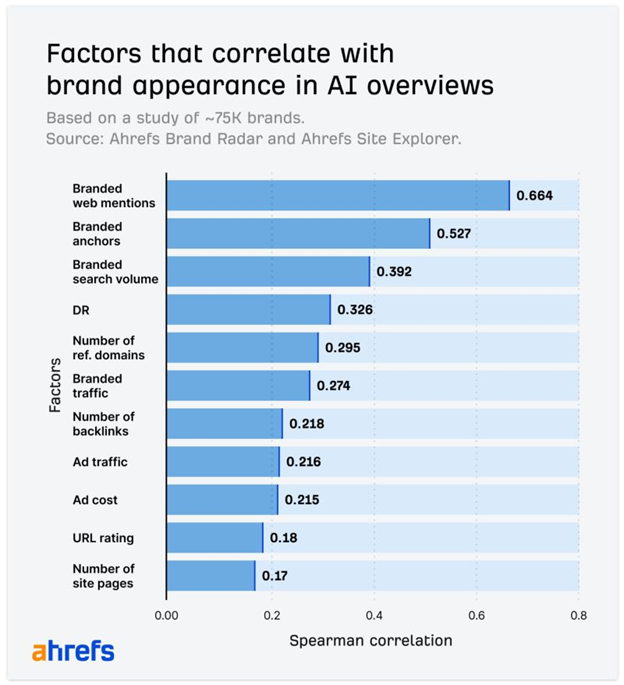
And that’s not the only trend worth mentioning here — AI and website clicks also reveal a positive correlation. Brands appearing within AI overviews for transactional queries get 3.2 times more clicks than traditional search results.
And as searchers shift to AI products, brands must act to find ways to get cited across them. Otherwise, they’re likely to stay behind in the race for visibility.
And that’s a wrap from our comprehensive overview of brand mention link building. It’s a slippery slope, but one that, if navigated correctly, can get you to greater visibility. If you need a partner to get you across, reach out to experts at Link Building HQ, so they can guide you through the process.