Every March since last few years, Google reassesses its algorithm, and like clockwork, a core update slips out through the SERPs-tains.
We see you, and yes, we went there.
The March core update of 2026 is still running its due course, but we’ve put together an early assessment of everything worth knowing right now—the patterns, predictions, and the noise you should probably ignore.
By the end of this blog, you’ll have a clear picture of:
- The timeline and order of events surrounding the March 2026 core update
- The volatility we’re seeing across the SERPs
- The impact you can realistically expect
- The first moves worth making once the dust settles
Timeline & Events
The March 2026 core update was the first broad core update of the year. It was released on March 27th, a day after the March 2026 spam update finished rolling out. The update applies to all regions, languages, and industries.
- The rollout took 12 days and 4 hours to complete.
- The previous core update was released in December, 2025, right around Christmas.
- Last year, the March core update started rolling out on the 13th day of the month.
- No article was uploaded by Google to announce the target and objectives of this update.
The Hypothesis Behind Timeline
So, a core update and spam update sandwiched on one another is not something we see every day. The last time we saw a back-to-back release was in 2024 and 2023. This occurrence is a little unusual and may indicate a few things.
- Google is releasing a combination of system alterations bundled as adjacent updates.
- Spam works like an initial sweep of the bad-quality content, so the core update can focus on the more advanced ranking factors.
- Higher fluctuations can be expected post-update.
Volatility Pattern of March 2026 Core Update
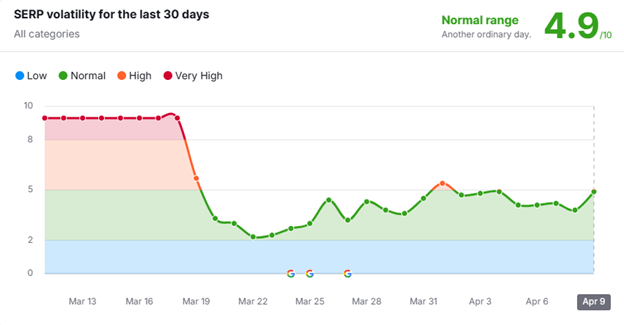
The volatility remained heated throughout the month of March, but the post-March 27th trend seems to be quite calm. Although it’s still too early to analyze what type of tremors may be specific to the March core update, it’s safe to say it brought some stability to the SERPs.
The Predicted Impact—What’s Likely Changing?
Since the impact is premature at the moment, it’s hard to say for certain what to expect, but we can forecast the changes based on historical data and the latest trends. Here’s what the impact of the March core update 2026 looks like so far.
Content Originality Endorsed
You may be creating quality content that serves user intent and provides value, but if it’s just a rehash of what competitors have already said, it’s likely to blend in as a drop in the ocean.
In this update, Google intends to promote original ideas and resources—surveys, case studies, expert guides, and research from original publishers.
Here’s one of the key questions Google recommends asking when evaluating content for quality.
“If the content draws on other sources, does it avoid simply copying or rewriting those sources, and instead provide substantial additional value and originality?”
So, it’s okay to leverage the existing data, as long as it integrates a hint of your own original ideas and work. A single page with proprietary data can outperform tons of thin pages, so make sure you’re prioritizing what matters.
Information Gain as a Ranking Signal
Building on what we already discussed, but with a new term attached to it: “information gain.” This term was first used in a Google patent and approved in 2022. The term may have been mentioned multiple times in Google research in the past, but this update is believed to be the first where it carries substantial ranking weight. The patent documentation explains the term as,
“An information gain score for a given document is indicative of additional information that is included in the document beyond information contained in documents that were previously viewed by the user.”
It’s basically the same idea as quality content, but with an additional condition attached: your content has to be original, integrate proprietary data, and offer unique insights to get a better authority score.
E-E-A-T Escalation
The good ol’ EEAT is once more endorsed with this update, meaning that sites that do not conform to these content standards may see drops. It’s expected that the March core update this year will reinforce this ranking signal more aggressively.
What we mean is that EEAT wouldn’t just remain a standard to assess a website’s content quality, but advance on to become a concrete metric causing ranking shifts. Let’s revise what EEAT really means:
- First-person language that signals direct, real-world experience rather than second-hand summaries.
- Consistent publishing within a focused niche that reinforces authority rather than offering scattered, unrelated topics.
- Fresh content or up-to-date information that reflects the latest developments in fast-changing or high-impact niches.
- Named authors with clearly linked profiles that showcase verifiable credentials, experience, and subject-matter expertise.
- Original images, screenshots, or data that prove the content is based on actual use, testing, or research.
- Citations from primary sources, official documentation, or credible research that support key claims.
- Author or brand reputation signals, such as mentions, backlinks, or recognition from other trusted sources.
AI Content Filtering
We mentioned in our March spam update analysis how scaled content generated using AI might be getting demoted. The core update can be used to expand on the same idea, targeting pages that go against Google’s guidelines for fair use of AI.
However, it should be clear that AI content is not automatically penalized unless it fails to meet the standards Google set for creating helpful, people-first content. It’s speculated that this update leverages the Gemini 4.0 semantic filter to narrow down low-quality AI-generated content.
When AI Could Be Helpful
To create content with editorial standards integrating a unique viewpoint.
To expand on expert input and reviews coming from real people and experiences.
To produce content that addresses search intent and adds value to a topic.
Parasite SEO Degraded
Remember when sites leveraging parasite SEO were completely wiped off the search results with the infamous September 2024 manual action penalty? Well, in March 2025, Forbes and other sites made a comeback, as reported in our update analysis.
Well, with this update, they might take a hit again. Sites piggybacking on a stronger domain’s authority to get ahead are likely to see drops in rankings. As page-level authority takes center stage in the March 2026 core update, individual pages will no longer be able to earn advantage for a stronger domain authority, systematically shaking the core of parasite SEO.
Thin Content Tanking
Thin content, such as one created for the sole purpose of ranking and keyword stuffing, was mutually targeted across both the March spam and core updates. While the March update took care of broader spam, core update is likely to sweep across more subtle forms of spam, like:
- Pages created solely for the purpose of stuffing keywords
- Shallow affiliate pages or comparison guides
- Scaled AI content with no original value or expert reviews
- Pages containing duplicate content
- Sites using content scraping as a primary ranking technique
With the March 2026 core update, you can expect steeper drops and visibility failures for sites producing content on these outdated and harmful tactics.
What To Do Next?
Now that the update has finished rolling out, it’s important to continue monitoring your visibility trends. Avoid making drastic changes immediately, as the full impact typically becomes clearer in the weeks following completion. And the real impact can only be gauged a few weeks after the rollout ends.
In the meantime, here are a few things you can do as a first line of defense.
Wait it out: The real impact can take up to fully reveal itself, so it’s best to stay patient. Keep track of your Google Search Console, but don’t react just yet. Otherwise, you’ll basically be administering a treatment plan without diagnosing the root cause of a symptom.
Keep a Track: Stay active on your tracking tools. Review progress over time, volatility patterns, and visibility drops. Keep track of dates when the drops and rises occurred.
Perform Page-Level Tracking: Review which pages on your site saw the sharpest drops.
- In GSC, open the “Pages” tab and sort them by clicks.
- Identify your top 20 pages before March 27th. Track those pages to see which ones saw major drops.
- Sort them by position and impressions to gather supporting data.
- Export the results in an Excel sheet.
- Audit the declining pages. Assess them for factors like content quality, page experience, and backlinks.
- Identify potential culprits before strategically optimizing for what your pages lack.
Analyze for Patterns: The declining pages are likely to indicate one significant pattern. Your job is to find out what it is.
- Are they all created using AI?
- Do they revolve around one topic cluster?
- Are they all listicle-type blogs or follow a mutually similar structure?
Identifying this pattern will help point out the reason behind the dropping traffic or impressions. You can then create a focused strategy to address the issue causing this drop.
With that, we wrap up our March 2026 core update analysis. We’ll be reviewing the impact regularly to highlight major shifts, industry-wise and generic. Stay tuned and stay up to date!