In SEO circles, there’s this notorious joke that “if you’re looking to hide a dead body, dump it on page 2.” It’s a real shame, to be honest. But also, the fact is that the 1st search ranking position on page one captures about 40% of a keyword’s total CTR. Page 2? It gets just 0.63% of the click share.
As a result, the popular question in SEO evolved from “How to get more traffic?” into “How to rank higher on Google?” There’s a correlation, of course. But seeing that a big share of search traffic is concentrated on the first page, employing a ranking strategy is the only viable way to fuel the traffic pipeline.
What are Search Rankings & Why Do They Matter?
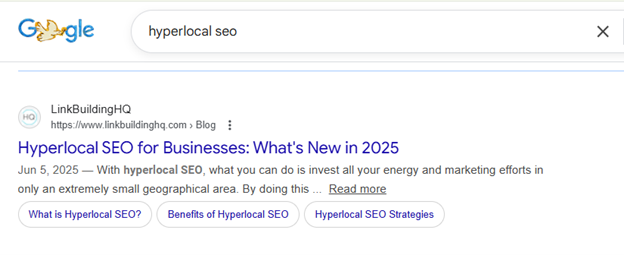
Search ranking refers to the position of a URL on a search engine’s results page. For example, for the keyword “hyperlocal seo”, we currently hold the first organic search ranking position.
But why is it important for websites to rank?
The answer is simple. To redirect more traffic to web pages for target keywords.
However, rankings don’t just mean getting to the top of Google search anymore. 2026 is a new ballgame altogether — thanks to the introduction of AI Mode and expansion of AI Overviews. The battleground has just gotten brutal, and the new trophy is visibility.
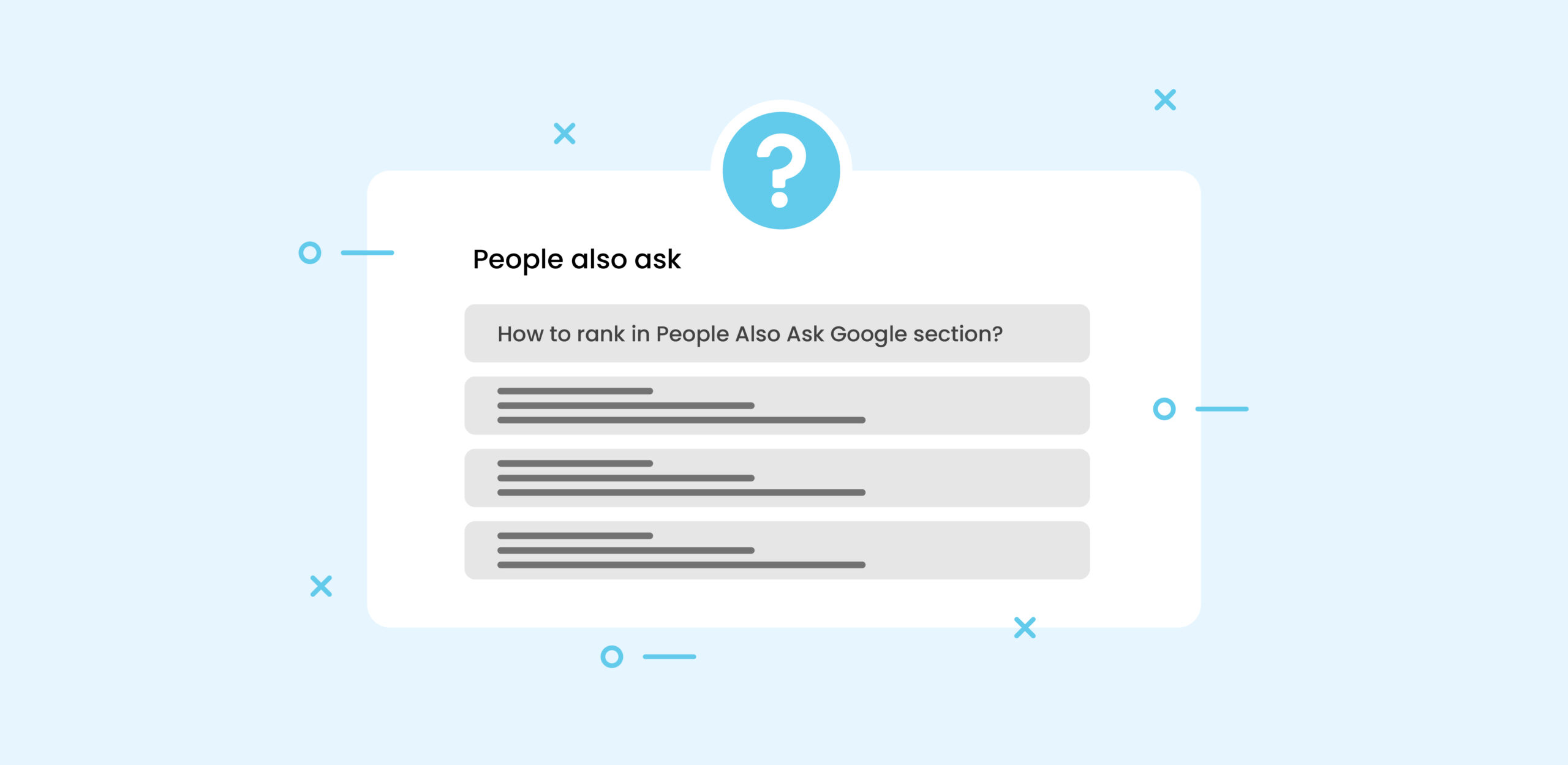
Higher visibility isn’t contingent on ranking entirely, it also requires getting cited in the AI Overviews, AI Mode, and other search features like PAAs and Rich Snippets. At least, that’s the strategy we’ve been operating on. And that’s what got us appearing in AIOs for keywords like “what is SERP tracking.”
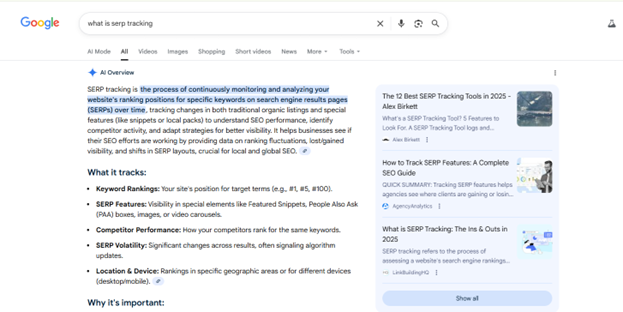
Recalibrating the search ranking principles can get you top spots for high-intent queries, like this one.
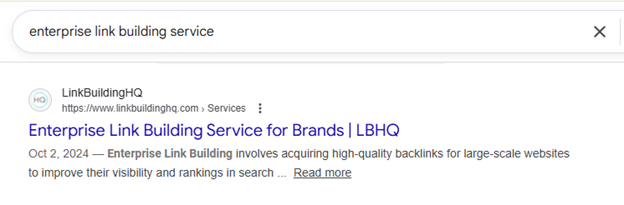
So if your broader objective is to rank higher on Google in 2026, the arrow should be pointed at high-visibility placements. That doesn’t just include organic search, but AIOs, AI Mode, and SERP features as well.
How Does Google Choose Sources To Rank in 2026?
Google doesn’t look at your content as a single entity anymore; instead, the algo has been wired to pull up information in chunks. Search Engine Journal reiterates this point, saying:
“…Google’s algorithms quickly assess topical depth by scanning your macro structure, extract specific answers from micro chunks for SERP features, and pull precise data points from atomic elements for AI Overviews.”
That’s why matching search intent is the priority, especially in 2026.
When you search for a query, it compiles not just the ten blue links, but a range of other search features that can all trigger clicks. So, it’s time to look at the bigger picture.
Here’s a breakdown of exactly what the system does when picking sources to rank.
- A searcher searches on Google.
- The intent of the search is determined.
- The most relevant pages are identified and pushed to the top.
- Some of these pages appear in organic listings, and others are compiled within search snippets, overviews, merchant listings, and other SERP features.
Ranking on Google means optimizing for the broader search experience, not just the top 10 results. The new search realm caters to queries at their core, highlighting answers before links and directing links to specific passages rather than the page as a whole. In essence, much has changed, and these changes are characterized by the following search ranking signals.
How Google Ranks Content in 2026
- Google matches intent at the passage level, which means content gets broken down into chunks and each piece is analyzed separately to rank at the micro-intent level.
- Content structure is more important than ever before because LLM chatbots trust text that’s easy to navigate and comes from trustworthy sources.
- A brand with a higher number of brand mentions is considered more authoritative. The game isn’t just about backlinks anymore, but what people really think of your brand across community platforms, social media, and forums.
- The algorithm uses page signals such as engagement rate, dwell time, and end-to-end user journey to determine how effectively a page addresses a query.
- The language and nature of a query determine what type of results are returned. For example, a query regarding restaurants in the Arabic language will pull up restaurants in the local area with Arabic content on their websites.
Our 7-Step Strategy To Rank on Google Search & Boost Visibility
Ranking is not a sprint; it takes time to strategize a plan that actually gets you to page one. After tests and trials with hundreds of content pieces, we’ve unlocked the most effective strategy to improve Google search rankings for any website.
Step 1: Identify Best-Performing Pages
In marketing, they suggest kicking things off where the returns are already rolling in. See which pages on your site are already doing well and create a list of the top 20 pages to re-optimize. This is your success zone, and working on it is going to ensure the existing traffic gets boosted to a significant margin.
The first step is to check website ranking on Google Search Console and identify top performers (pages ranking between 11th and 20th positions).
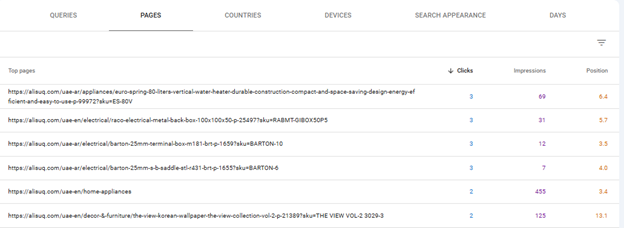
These pages need a little push to get the traffic flowing. Follow these steps to begin:
- Go to GSC dashboard and select your property.
- Navigate to the performance report and scroll down to find “Pages.”
- Export a CSV of this and narrow down the page count by separating the pages ranking in positions 11-20.
- Identify their target keywords and start optimizing.
Step 2: Analyze Competitors’ Content to Beat them at their own game
Now that we have a list of pages to target, get ready to aim for the top positions held by competitors. The goal is to find what is ranking on page one, identify gaps, and fill them to capture top positions.
How to Run a Comprehensive Competitor Analysis
Benchmark the first 3 websites on the Google search ranking page. Assess these pages for ranking factors specific to content, user experience, and link profile. Here’s a step-by-step process to cover all bases.
- Assess the quality and depth of content. Is it written on EEAT standards? Is it generic or does it stack on topical relevance? Review the content format and structure. Check if there are non-text elements used, like video, images, and other interactive elements.
- Analyze content gaps that can help you outrank them, such as a lack of visual elements, content that reads flat, or one that isn’t structured properly.
- Perform a backlink gap analysis on Semrush or other third-party tools to review which referring domains could be contributing to their rankings.
- Check page speed and mobile accessibility to identify technical gaps.
This is essential to uncover weaknesses in your and your competitors’ strategy, giving you the foundational groundwork to begin optimizing for improved search rankings.
Step 3: Get The Basics (of SEO) Right
Traditional SEO never gets old, no matter what type of pages you’re trying to rank. Besides matching search intent, off-page factors can be critical in determining whether your page gets picked up by the algorithm or not. So, if you’ve been asking yourself how to improve SEO on Google, start with on-page and off-page optimization.
Sprinkle Relevant Keywords In Content
Answering search queries in content is the fundamental rule for creating SEO content. Targeting terms people use to search for your niche information is mandatory to help crawlers interpret the context of your pages. Google expands on this, saying that:
“To give you the most useful information, Search algorithms look at many factors and signals, including the words of your query, relevance and usability of pages, expertise of sources, and your location and settings.”
Sprinkle relevant terms throughout the content to signal semantic relevance. Make sure that your heading, meta title, and description also contain the primary keyword to send powerful relevance signals. Use a descriptive URL and add keywords in the slug as well. Using a holistic approach to keywords ensures your content gets picked up for targeted queries.
Link Internally to supplement internal navigation
Internal linking is done correctly when it helps users on a site discover content in a more efficient manner. Including clear and descriptive anchor text helps, but relevance should not be overlooked.
The simple rule is to find which pages can actually help users find out more about a topic you’re referring to and link to it! Simple and effective.
Plan Topic Clusters to establish strong topical authority
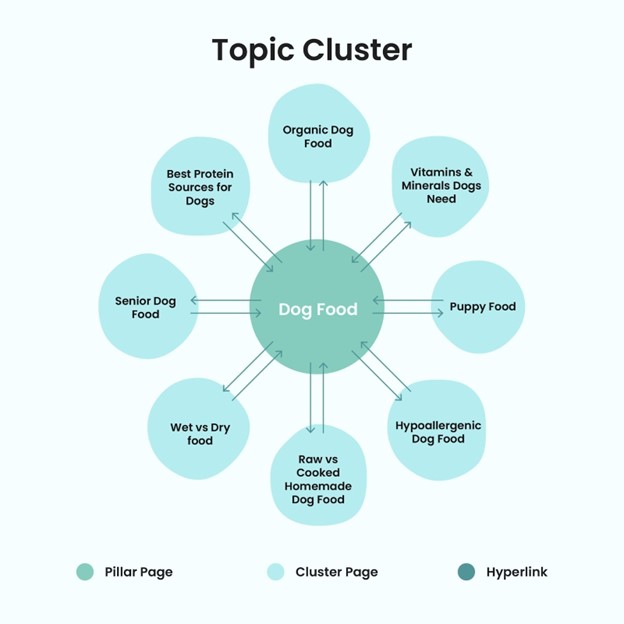
Topic clusters are a huge part of building topical authority. They let you expand on a topic your expertise lies in, and then link it internally to pass link juice across the site.
Creating a topic cluster is pretty simple. You pick the core topic for the pillar page and brainstorm relevant keywords for it. The subtopics will be used as cluster pages for the broader topic. For example, if our pillar page is about dog food, the cluster pages could be.
Organic Dog Food
Best Protein Sources for Dogs
Vitamins & Minerals Dogs Need
Senior Dog Food
Puppy Food
Wet vs Dry food
Hypoallergenic Dog Food
Raw vs Cooked Homemade Dog Food
Strengthen Off-Page Factors
On-page optimization will only boost search rankings when combined with off-page efforts. Without it, it would be like optimizing an engine but never adding fuel. Plus, it’s a mandatory part of the SEO basics.
For off-page optimization, there are a few key principles to follow:
- Pages must be crawlable and indexable.
- Any pages blocked by robots.txt should be assessed and removed, if required.
- Building a strong backlink profile to strengthen domain authority.
- Optimizing for local searches (more on that later.)
- Brand mentions across niche communities, forums, and social media.
Nail these down before adding on advanced strategies to crawl up the SERPs.
Step 4: Fulfill Content Signals
Google algorithm doesn’t just operate on a set of predefined ranking signals; it also picks up real-world signals like bounce rate and scroll depth. And these can impact your chances to rank, because they’re used to determine how helpful your content is to searchers.
So next time the question pops up in your mind: “how to boost my Google ranking?” Remember, the answer lies in satisfying advanced content signals like time on page, bounce back rate, and pages per session. We have explained the non-traditional metrics in our recent blog, check it out to see what you should be tracking besides keywords.
If your content fails to hit content signals, it’s probably considered low value and may be ignored by the algorithm. But you can reverse that using the following tactics.
Answer key questions first
In the era of zero-click searches, you can’t expect people to scroll through an entire page to find an answer. If you want to surpass search features like AIOs and Discussions, lay out your answer right in the first paragraph.
A great way to do this is to first mention the question and directly answer it in the following sentence. Just like we did in this blog.
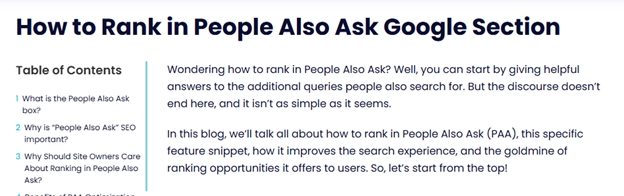
That’s how you lure in readers to keep digging. Lead with the answer and a promise to expand on the topic.
Use Clean, Scannable Formatting
Your content shouldn’t look like pieces of a puzzle scattered around an empty canvas. It should all make sense, have a clear structure, and be easy to skim.
Since LLMs and AI engines parse information to understand content, breaking it up into chunks is a great strategy. But make sure that each chunk relates to the information above and below. This way, it’ll be easier for AI and search crawlers to find answers in your content and cite it as a source.
Break Up Your Content with Visuals and Examples
Visuals diversify content and make it easier to consume. Essentially, these are supporting elements that come together to deliver value to users. Plus, no one wants to read a page that’s all text; the eye seeks diversity.
So, when creating pages, make sure it incorporates visual elements like
- Infographics explaining concepts and ideas in an easy-to-digest visual.
- Screenshots to give examples or elaborate on a subject in the text.
- Before-and-after illustrations of concepts and ideas.
- Charts and graphs to prove a point.
Leverage Videos for higher dwell time
Dwell time is part of the content satisfaction signal, and a video can significantly boost this metric. When you insert useful videos in your content, users spend more time on the page, signaling to search engines that this page is useful and valuable.
So instead of text-heavy pages, consider adding videos showcasing:
- Step-by-step guides to a process.
- Customer testimonials.
- Interview with experts or Q&A sessions.
- Brand stories, etc.
Update Content Regularly
If you analyze the SERPs extensively, you’ll realize that most organic listings are recently published pages. This is because the algorithm prioritizes fresh, updated content.
We’re not saying that; Google is:
“…when searching for current news topics, content freshness plays a bigger role than dictionary definitions.”
This isn’t just limited to new websites. Niche sites should never rely on outdated content either. To keep your content current, regularly monitor pages that are losing search rankings, traffic, or clicks. Update these pages with the latest information, align them with current content standards, and incorporate the elements that are helping competitors gain traction.
Step 5: Structure Content for Clarity & Skimmability
Next up, content structure.
You may have all the best elements for quality content—depth, visuals, user intent, and freshness—but unless it’s structured properly, search crawlers may not be able to scan it with accuracy.
Your page might still rank, but you’ll be missing out on high-visibility spots like AIO citations and the PAA snippets.
“Write content naturally and make sure the content is well written, easy to follow, and free of spelling and grammatical mistakes.”
Use our tested content techniques to gain an edge on the ranking page.
Insert Table of Contents
Table of contents with jump links is perfect for long-form blogs. It helps scrollers and crawlers easily navigate through different sections of a blog or article. Moreover, it reinforces structural coherence across the page.
Add Headings in a Logical Order
For search engines, headings are checkpoints, helping users and crawlers understand context, hierarchy, and relevance at a glance. That’s why it’s important to follow a clear hierarchy to ensure users stay engaged. Plus, it also assists crawlers in interpreting each part of content and rank it in various search features.
A three-thumb rule we follow is: keep it relevant, scannable, and neat.
Use a Diverse Range of Content Formats
If you’re not sure how to increase Google ranking positions across different search features, we have a secret sauce to boost your visibility. Match search intent and target all search tabs, not just the “All” tab. Using a range of formats allows crawlers to gauge your content for different search tabs. So, consider adding content variations like:
- Tables
- Bullet points and numbered lists
- Images/Infographics/Diagrams
- Quotes and expert insights
- Callout boxes or key takeaways
- Videos
- FAQs
Content satisfaction signals build momentum over time and reinforce long-term search ranking performance. By adhering to the simple principles, you’ll significantly hike the satisfaction rate of both users and search engines.
Step 6: Make Sure There Are No Technical Insufficiencies
Technical optimization is a critical part of the SEO puzzle, ensuring your UX is seamless and there are no glitches in the website operations. For businesses trying to improve Google search results, implementing technical SEO is a must.
Improve Site Speed
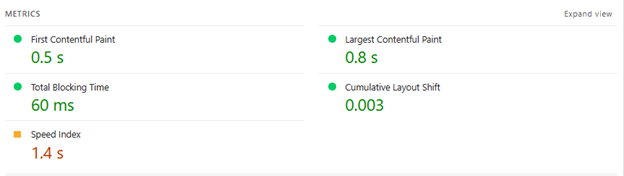
Site or page speed is a direct ranking factor. It’s listed in the Page Experience guidelines and considered an important part of the Core Web Vitals metrics.
Page speed is basically a measure of a website’s loading performance. A slow loading speed drives up bounce back rate, signaling that your content does not fulfill the search intent.
Google provides an in-house tool to measure this speed and assess any insufficiencies. If the score is below 89 on PageSpeed Insights, it may send negative satisfaction content signals and consequently hinder the ranking needles.
Mobile Friendly
Besides other things, a mobile-friendly site reduces bounce rate. Since mobile devices account for 62.54 percent of global website traffic, search engines associate mobile-friendliness with credibility and user satisfaction.
That is why a website that loads fast, has a responsive design, and is easy to use sends stronger ranking signals.
Other Technical Factors
There are other primary technical factors, which, if not optimized, can impact a website’s discoverability and ranking potential. Follow this checklist to review if your site is ready to rank, technical SEO-wise.
- Ensure pages are crawlable and indexable.
- Get a secure HTTPS connection (make your site SSL verified).
- Implement Schema to enable visibility in rich snippets.
- Remove intrusive dialog boxes or pop-ups.
- Use supported image and video file formats.
Step 7: Satisfy Local Search Metrics to Get visible for local searches
When regional businesses optimize for local keywords, it helps them appear on Google’s search features like:
- Local Pack
- Google Maps
- Google Business Profile (GBP)
- Knowledge Graph
For such keywords, Google returns results based on search intent and location. That means local search optimization allows you to improve visibility on local searches and appear for the above-mentioned search features.
But local search rankings are contingent on optimization strategies like:
Providing Complete Business Information
A partially optimized business profile leaves a lot of blind spots for search crawlers, which is likely sending negative signals from your profile. That is why a complete and up-to-date business profile is the first prerequisite to get listed in local search rankings.
Make sure your full business name, address, and phone number (NAP) are listed in the GBP. This should be consistent across all local directories. Mention any other specifications for your business, like working hours, Wi-Fi availability, and service details.
Google algorithm now picks up keywords from customer feedback or the comments section as well, so make sure these sections portray a positive brand image. Not just that, it seems Google is also picking up social media signals to highlight tags on local listings. Darren Shaw talked about this recently, and it’s quite an revolutionary move for local search.
Align On-Page Factors for Local Visibility
If you’re trying to rank for local search terms, it goes without saying that your content should be focused on the same. For example, a car maintenance shop in downtown Philadelphia will target keywords like “car maintenance philadelphia,” or “best mechanic near me” besides generic search terms like “car maintenance shop.”
For cross-country businesses, creating landing pages specific to each location is also a good practice and helps visibility on various local listings. Suppose you’re a tire supplier with many branches across the United States. Creating dedicated landing pages for each region is going to help redirect the target audience to your website.
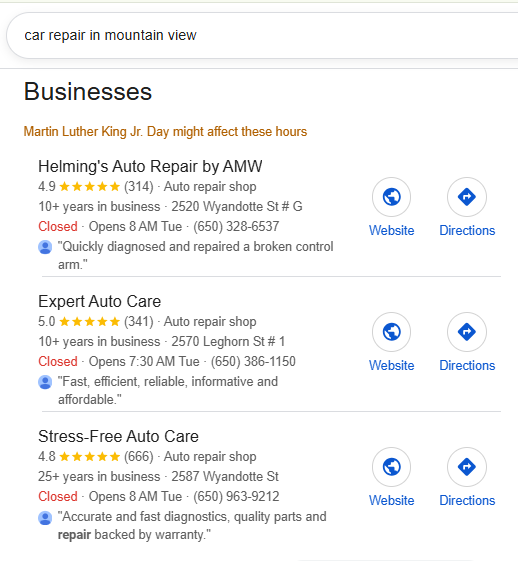
Implement Local Schema:
One more way to rank higher on Google local search features is to implement local schema. There are different types of schemas local businesses can benefit from, including (a) Local Business Schema, (b) Review Schema, and (c) FAQ Schema.
This will ensure your business is eligible for rich results like this one.
The Closing Remarks
And there we go, a guide covering every optimization tactic under the sun to help sites rank. But the answer for how to rank higher on Google search is one tied to the cause of low rankings, not just the listed search ranking factors above.
For some, updating content might do the trick, but others may need to implement a comprehensive technical audit to get the needle moving again. Simply put, the answer lies in the diagnostics. Figure out what you’re lacking and fix it to outrank competitors.