Ranking on Google isn’t an absolute marker of your brand visibility anymore. With LLMs in the mix, brands may have to rewrite their entire visibility playbook.
In 2025, AI adoption rate was 38%, and the trend may just keep rising in the coming years. This means that if you’re showing up in AI answers, you’re on your way to dominating the search realm.
In this blog, we’ll get down to the basics – what AI visibility is, why it matters, and how to track it.
What is AI Visibility?
AI visibility refers to getting cited, mentioned, or recommended in the AI answers. A brand that frequently gets featured in LLM responses like ChatGPT, Claude, and Perplexity has higher AI visibility.
Unlike the ten blue links that appear in Google search results page, AI visibility is about becoming part of a conversation between a chatbot and a human.
What counts as being visible in AI Platforms?
- Brand mentions that lead to higher brand awareness and trust.
- Citations and source links in AI responses that cement your credibility as a thought leader.
- Products and services getting recommended in AI answers, which may turn into real leads.
- Presence in AI summaries or answer boxes within traditional search results.
How to Track AI Visibility & Why It’s Important
Before 2022, people used search engines to find answers to their queries. With AI and LLMs in the mix, things have taken a sharp turn.
User behaviors are shifting faster than your morning coffee cools down. Today, people are more inclined to conversational queries with AI bots than searching for long tail keywords on Google. So, it’s critical for brands to find a way to keep up with the growing inclination towards AI search.
Generative AI search engines like ChatGPT, Perplexity, and Gemini work as online consultants, helping searchers make decisions about brands and products. These AI chatbots aren’t just making conversation; they also shaping consumer opinions and choices. That’s why their power to drive traffic and leads should never be overlooked.
Research suggests that 52% of Americans use AI platforms on a weekly basis. If you’re showing up in their conversations, you’re probably one step ahead of your competitors.
In fact, AI users also convert better. A study by Semrush highlights projected visitors for traditional vs AI search in the upcoming years. See how the red line takes a sharp upward turn? It represents the potential of a brand’s growth through AI visibility.
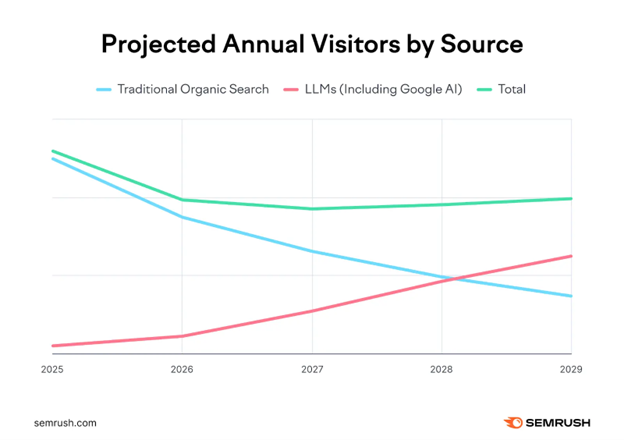
Here’s our take on this. Master AI optimization to tap into a whole new stream of qualified traffic. The more a brand gets mentioned, the higher its “share of voice” and, consequently, conversion potential.
AI Visibility vs Traditional SEO Visibility
Traditional SEO focuses on optimizing for the list of links on Google’s search engine results pages. Contrary to that, AI optimization works to establish a higher probability of AI search engines citing or mentioning you.
Since most AI tools extract answers from existing sources on the web, it won’t be wrong to assume that your traditional search visibility also plays a role in determining how much AI values your brand.
But then how does optimization differs for the two?
How Optimization Differs
You may already be tracking your SEO visibility, but AI tracking fills a critical gap. Combining the two ensures you’re merging visibility across the two key discovery channels.
Here’s how traditional SEO and AI differ:
- SEO optimizes for rankings in search results of traditional search engines like Google, Bing, and Yahoo. AI narrates and interprets your content to synthesize answers.
- AI assistants’ answers include paragraphs, lists, tables, and images, etc., whereas traditional search needs you to navigate through multiple sources to find an answer to your queries.
- AI taps into a broad array of online sources to produce “definitive statements about a brand.” This includes news sites, customer reviews, social media, and branded content. SEO mostly uses ranking signals like structured content, dwell time, scroll depth, and page authority to rank.
- AI brand placements could vary, and it’s not necessary that there will be a direct link to your website in the responses. On the other hand, search engines directly redirect searchers to your page of reference.
Factors That Influence AI Visibility
Now, in order to optimize for AI, you must first understand which factors can boost your chances of getting cited or referenced in LLM responses. This is analogous to ranking signals in SEO, and are called the AI visibility metrics.
Quality of Content:
How well are you answering common user queries? Directly addressing queries boosts the chances of AI citing you. Producing authoritative content with clear, concise answers sprinkled throughout acts as a marker of your expertise in a subject.
Branded Mentions:
This isn’t just about backlinks, but how frequently your brand is talked about across all digital channels. When a brand is frequently mentioned on the web, social media, forums, and reviews, it indicates to AI engines that it’s worth mentioning.
Data-Backed Content:
Another factor that helps reinstate the authority of a website’s content is how often its content features tangible data. This may include citing sources, adding statistics, and using quotes from experts. Essentially, a source-intensive article can boost AI visibility by 30-40%.
Search Ranking Positions:
Yes, your search ranking positions on traditional search engines can correlate with a higher visibility in generative AI responses. A study by Seer Interactive reinforces this, pointing out:
“Brands ranking on page 1 of Google showed a strong correlation (~0.65) with LLM mentions. Bing rankings also mattered but less so (~0.5–0.6).”
So if you’re optimizing for SEO, you may just be killing two birds with one stone.
Structured Data:
Implementing schema can help LLMs understand a website’s content better and deliver more contextual answers. Fabrice Canel from Microsoft’s Bing admitted in SMX conference that Microsoft uses schema to help its LLMs understand and learn.
User Experience:
While not a direct visibility metric, websites with a seamless user interface and seamless navigation are inherently more accessible for LLMs. When a website is technically sound, it helps both users and AI bots find what they need.
How AI Systems Retrieve and Generate Answers
AI search outputs aren’t like human conversations; they’re characterized by mathematical assessments, code recognition, and query identification. Since all this work is done in hindsight, most of us don’t know how answers are generated.
But if you’re planning to leverage generative engine optimization (GEO) to ace visibility across all AI visibility monitoring tools, it may help to know what goes on behind the scenes.
Pre-Training: Most AI models are trained on large datasets, including books, articles, code, and websites. This is where its “knowledge” comes from. It learns patterns, facts, grammar, and reasoning from this data.
Retrieval-Augmented Generation: Implementing RAG allows AI manufacturers to merge existing training data with a retrieval system that allows AI to access external data. This enables generative tools to perform real-time research across the web to yield accurate and up-to-date responses.
Forming Tokens of Information: When you search for a query, the AI breaks your input into small chunks called tokens (roughly words or parts of words). It basically means breaking down a query into smaller chunks so the system is able to read your prompt mathematically.
Context Retrieval: Next, the model processes all existing tokens from your current and previous conversations to make out exactly what you’re looking for.
Real-Time Search: Some tools have browsing enabled, which lets them perform real-time searches to generate a contextually correct answer. This information is fetched from live pages, social media, forums, and other online sources.
Token-by-Token Response: The model then proceeds to curate an answer for each token and combines them together. Each token is the statistically most appropriate next word for everything before it. It’s quite a sophisticated method, to say the least.
And this, my friends, is how AI search pipeline works. It rides on the theory that effective models draw on real-world content and authority to determine their sources—the same factors often associated with SEO. To get listed in these answers, having authoritative content and trust signals is a must.
How to Track Brand Visibility in AI Search?
You know which factors contribute to AI visibility, and you’ve optimized to gain an edge. But how do you know you’ve actually outdone your competitors in the AI visibility battle?
Well, for one, an AI search visibility tracker may help, but you can also analyze progress manually.
Manual Prompt Monitoring
So, an easy way to check whether users are seeing you in AI answers is to enact a user’s search journey.
You must already know what type of prompts you want to target. Create a list of them and run them through popular tools like ChatGPT, Perplexity, and Gemini.
For example, we gave ChatGPT the following prompt:
What are the best link-building agencies in the US?
It listed us at number 4 on the list. This helped us track our visibility in ChatGPT answers for our key query.
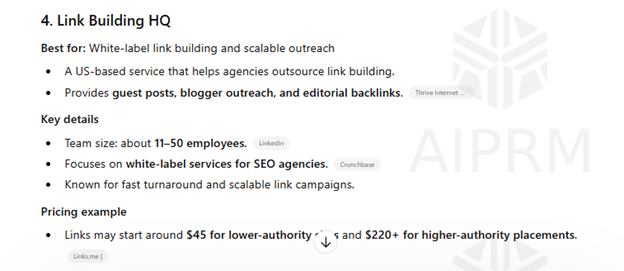
You can follow the same process to analyze your visibility on other AI search platforms.
Positive visibility signs include the following:
- Getting mentioned by name.
- Getting referenced or cited with a link.
- Mention featuring a positive association with the brand.
Tools for Tracking AI Visibility
AI search engines do not provide a dashboard like GSC for you to track your progress. But there are dedicated AI visibility tools supplied via third-party manufacturers that may be helpful.
Here are the most popular AI visibility tracking tools with higher accuracy in insights.
Wix AI Overview
The Wix AI Overview tool is compatible with mainstream AI platforms like ChatGPT, Gemini, Perplexity, and Claude. You can pull up your overall AI visibility score for any of these tools on the tool dashboard. Wix claims that this score is based on your overall percent visibility for questions.
How to Use It
On the tool dashboard, you can select the AI search engine you wish to analyze. Here, you can review:
- Total site sessions
- Traffic trends over time
- Pages are bringing the most traffic to your site.
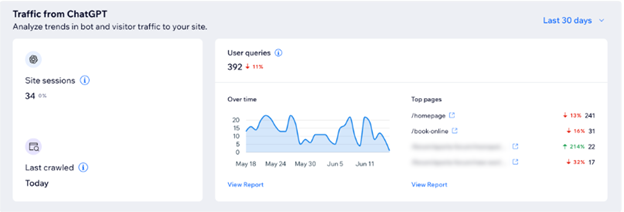
If you dig a little deeper, you will also be able to spot top competitors overtaking your cited positions in AI answers.
Besides that, it also detects and visualizes AI bots roaming across your website pages in real-time. The fluctuations can be attributed to your authority and reputation as a brand on AI platforms, because the more AI engines trust you, the higher bot traffic will be sent to your website.
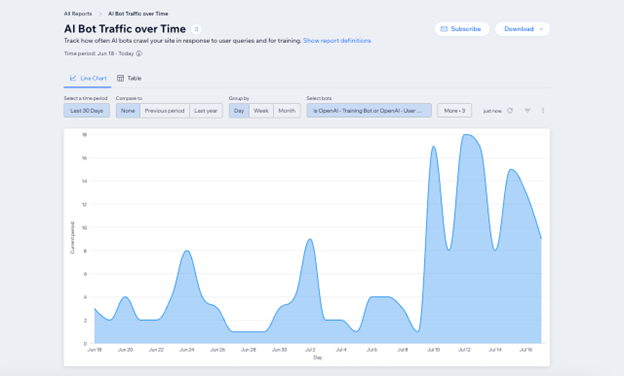
While this tool is only accessible to users with a Wix Business Manager at the moment, if it pans out, it can be a big deal! Because we’re talking about getting a crystal-clear snapshot of your site’s performance — on leading AI search engines that are literally reshaping how people find information online.
Semrush
Semrush provides a great resource to track your presence in AI responses for target prompts. It’s called the Semrush AI Visibility Toolkit.
This toolkit monitors your mentions dynamically and brings everything into one place, including share of voice, brand sentiment, number of mentions, and non-branded queries.
First, it gives you a compounded visibility score for your brand. This is an overall scoring metric that helps understand how well a brand is performing in terms of AI visibility.
You can then compare your visibility against competitors or find new prompts to target (those that your audience tends to use frequently).
Ahrefs
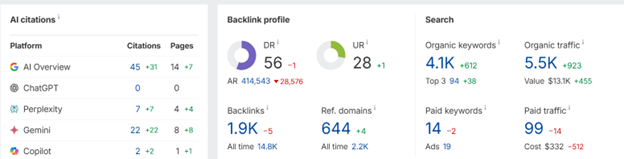
Ahrefs actually provides AI insights right there on your main Dashboard. You can get quantitative insights into AI citations, as well as top pages for each AI engine.
However, you may need to pay for them as add-ons to your existing package before you can access detailed data for each AI search engine in their directory.
Takeaway:
So, AI visibility tracking is mandatory, especially with the rapid shift towards AI-based searches. And the tools we discussed above can be a big help in this matter. With these, you can analyze the average performance of a website on AI engines, the industry-based query trends, and which competitors you’re up against in the LLM visibility battle.
Although there’s one loophole with AI tracking that we barely talk about. AI responses can be inconsistent, and that means tracking can not give you a definitive picture of your performance. It can, however, help to concretize your GEO efforts and get a sense of which topics you should be targeting. With that, we take our leave. Good luck with your AI visibility tracking and optimization!