
How to Get State-Specific Backlinks in USA

On this page
See how we support link building across different industries.
Explore Our IndustriesBuilding state-specific backlinks in the USA earns authority in the region where your business is based, not just in broader search. And that’s what makes state-targeted backlinks the backbone of local SEO.
In this guide, we break down what state-specific backlinks are, why they carry more weight than generic links or citations, and how to actually earn them.
What Are State-Specific Backlinks & Why They Matter
State-specific backlinks are links earned from domains with genuine topical or geographic ties to a specific U.S. state, such as Florida, California, or Mississippi. These links come from regional news outlets, state trade press, state chamber-adjacent sites, region-focused blogs, or discussions happening on forums specific to a particular state.
Let’s understand this further with an example. A shoe store based in Florida runs a link-building campaign to pop up more frequently in the “near me” searches, local packs, and map listings in Florida. To get there, their best bet is to focus on niche sites, publisher blogs, and review sites based in Florida rather than the generic US region. This will help zero in their efforts to a specific state, so they don’t acquire generic authority across regions irrelevant to their store’s physical location.
The definition makes more sense once you separate it from three other backlink types commonly confused with state links.
State-specific backlinks vs. local citations.
Unlike state links, local citations work as your business’s profile instead of a contextually placed link that adds value to a relevant content piece. They come from directories such as Yelp, Yellow Pages, or Chamber of Commerce member lists, which contain business names, addresses, phone numbers, working hours, and other relevant details. Essentially, it’s structured data used to help strengthen your eligibility for local features. Meanwhile, state-specific backlinks allow you to compete for a listing on Google’s local SERP features.
State-specific backlinks vs. city/hyperlocal backlinks.
Both carry geographic relevance, just at different zoom levels. While state-specific backlinks target a broader physical area, hyperlocal backlinks impose further geographical limitations on link acquisition. For example, a link on an Austin neighborhood blog is more targeted than a link from a Texas trade publication. The latter will fall under the state-specific link-building umbrella while the former is hyperlocal. It’s also important to note that they’re not objectively different but stack on each other to improve local visibility.
State-specific backlinks vs. national backlinks.
A mention in a large industry blog site with no regional identity indicates your credibility in your field but carries no geographic signal. It won’t move the needle for “near me” searches or help you appear in the Local Pack. This is the mistake behind most backlink profiles that look strong on paper but don’t translate into real rankings.
What Makes A Good Quality State-Specific Link?
Not every backlink from “somewhere in your state” carries the same weight. The most valuable state-specific links share a few defining traits:
- The link sits naturally within the body of a content-rich page, not buried in a sidebar, footer, or generic resource list.
- The site itself is based in, or clearly serves, the state you’re targeting.
- The link isn’t just regional; it’s also relevant to your industry. For example, a link from a state-based finance publication is more valuable to a fintech company than a link from a state-based lifestyle blog.
- The link is dofollow and passes link equity seamlessly.
- It comes from a recognizable regional outlet like a local business journal, industry trade press, city/state lifestyle media, and local news or community sites
The Role of State-Specific Backlinks In Local SEO
Why do state-specific links matter for local SEO? How do they help boost authority and visibility across search engine features unique to local audiences? Here’s how.
Better Intent Matching
Google is now fully equipped to cater to “near me” searches. As searchers evolve, keywords like “restaurants in toronto” are becoming less frequent because searchers prefer to search by the “near me” phrase. And once someone searches “near me,” they’ve already decided what they want; they just need to know who’s close by.
That’s a high-intent moment you can catch with state-specific links that target both the broader (“restaurants in toronto”) and narrower (“restaurants near me”) context of the query.
Stronger Local Signals
State-specific links strengthen local signals to help a website earn more ranking positions for locally relevant search terms. In Whitespark’s 2026 Local Search Ranking Factors research, they outline the top local organic ranking factors and list ‘quantity of inbound links to domain from locally relevant domains’ in 13th position, establishing a direct correlation between local backlinks and local visibility.
This reiterates the idea that locally and industry-relevant links carry real weight in local ranking algorithm. They may even have a close tie with reviews and NAP signals.
Competitive Edge
While most of your competitors will have their NAP data submitted to Google Business Profile and local directories, very few actually invest in location-based link building. Editorially placed backlinks earned via genuine editorial relationships on regional sites give you an edge against top industry players.
While state-specific links may not be the single most important lever in local campaigns, it’s the one factor few local competitors are actually pulling well, making it a real differentiator.
Local AI Visibility
When you’re building state-specific links, you’re not just gaining an edge on traditional search, it also pushes your local AI visibility graphs up a notch. Google’s AI Overviews, Gemini, and tools like ChatGPT and Perplexity are now increasingly handling “best [service] in [city]” and “best [place] near me” queries. And to generate relevant answers, they prioritize businesses with consolidated signals across the website, local reviews, and third-party mentions.
For example, a home improvement contractor that’s regularly featured in state and regional business journals leaves behind a stronger trust trail than one that never gets recognition in local press, media, or state magazines. That’s a signal not just for traditional search engines but for AI engines as well, making regional links a critical component of AI search optimization campaigns.
Precise Franchise Targeting
Multi-location and franchise businesses can expand their wings across states with a targeted strategy unique to each region, city, and neighborhood. This way, each of their location pages will compete for high-intent terms in the region of interest rather than diluting authority of irrelevant pages on the site.
For example, Taco Bell is a US-wide fast food chain with at least one local franchise in every state. However, when a searcher in downtown Tennessee searches “tacos near me,” the results page will only show them local menus and ordering pages. That’s a sign of good local SEO. It shows their strategy hinges on core local SEO principles like geographic keyword mapping, geo-targeted backlinks, and store-level structured data, all of which help deliver the right pages to the right audiences.
How to Actually Earn State-Specific Backlinks: A Step-by-Step Guide
Acquiring state-specific backlinks is best done using an integrated link-building strategy focused on local link building, niche trends, and geotargeted keywords. Here’s a step-by-step approach that actually works.
1. Audit Your Current Backlink Profile
Run an audit of your existing backlink profile and find all local backlinks, including national, state-specific, and local citations. Now split them up to create a clear distinction between each type. This will help separate broader regional links from state-specific links. It will also allow you to map out the backlink requirements specific to your target state.
2. Examine State Competitors
Check for keywords, referral sites, and anchor text competitors are using and reverse-engineer their strategy to gain an edge on local search. For this, you may need access to a third-party backlink analysis tools offered by Ahrefs, Semrush, or SE Ranking. If you’re using Ahrefs, the process is pretty simple.
Go to the Keyword Planner tool and search for a keyword you want to rank for. Review the top-ranking sites for that keyword and check their backlink data: the total number of inbound links on that page, the referring domains, and the anchor text. Replicate it to compete for that keyword.
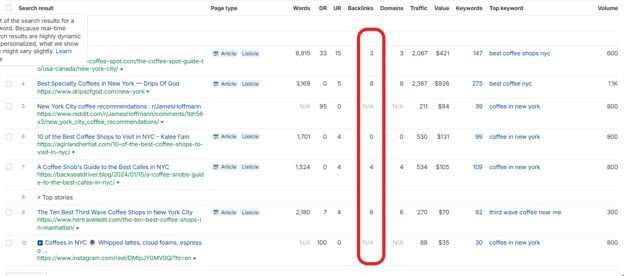
After scraping relevant competitor data from these tools, build a target list of state-relevant publishers, organized by industry. Pick the ones that are realistically reachable in your market and target keywords with a strong local intent. Prioritize outlets whose past coverage matches not just your state but your industry too.
3. Create Locally-Relevant Content
For state-specific link building, generic content most often falls short. To encourage local visitors to your site, it’s important that your content aligns with local and state trends. Start with local market reports, state-specific guides, and original local data/surveys reports to give publishers a reason to link to you.
4. Outreach with a Local Angle
Generic pitches aren’t getting local publishers interested. Which is why many expert local link builders add a regional spin to their outreach emails to draw their attention. Because regional editors and journalists respond far better to pitches tied to state trends, local regulations, or community news, it’s a good practice to make your pitches locally relatable.
5. Scale Campaigns Across States
Multi-location and franchise businesses should treat state-specific link building as multiple campaigns running in parallel, each with its own unique targets and keywords. Because to scale link building cross-state, each branch and city needs its own publisher list, its own local angle, and its own outreach cadence.
Some businesses may get tempted to treat it like one big national campaign with templated pitches and generic prospecting. Unfortunately, this strategy doesn’t help scale the process. In fact, it draws down margins with little to no localized presence.
A strategy built around Ohio’s home-services publications won’t translate to California’s, even for the exact same service line. What stays consistent across every market is your NAP data and brand messaging; what has to adapt is the publisher targeting and the local hook in every pitch.
6. Track & Replace
Once you’re done placing links and earning those much-deserved positions, monitor your profile to keep the streak going. Track state-specific links regularly to catch and fix link-building failures in time. Regular monitoring ensures you’re up to date on important fixes. A simple monitoring routine should answer three questions:
- How many links are broken and why?
- Do I need to re-outreach to replace old links that were lost?
- How many more links should be created on the website to get back on the competitive wagon?
Keeping track will keep your positions steady and link profile healthy, so you don’t lose local visibility because of failure to audit state backlinks.
Common Mistakes to Avoid When Building State-Specific Backlinks
You may think you’re doing everything right, but sometimes small mistakes can cause huge visibility losses, especially when targeting a localized region within a country like the USA. Knowing these mistakes in advance will save you a lot of trouble and revenue in the long run.
- Confusing citations like directory listings and resource pages with true editorial state-specific backlinks.
- Chasing low-quality “write for us” state pages that deliver no real value to help localized ranking factors.
- Using the same generic pitch across all 50 states instead of customizing it to each state. Ignoring industry relevance in favor of geographic relevance alone. Your link might be placed on the right state site, but if it isn’t relevant to your niche, it’s doing little to boost your link profile.
- Expecting instant results from campaigns. Realistic placement take time, and rankings should be considered a long term goal.
- Not tracking or replacing dropped links over time can lead to lost positions.
DIY vs. Working With a Local Link Building Service
Let’s be honest, finding prospects for state- or city-specific link building is harder than generic outreach. That puts business owners in a tough spot: is it really worth doing all the work yourself, or is it better to outsource local authority backlinks?
The answer isn’t simple, because it varies with business size (SMEs vs. enterprises), industry, and search objectives. DIY link building requires time, in-state publisher relationships, ongoing outreach, and content creation. If you have the team and resources to carry out state-specific link-building campaigns, great. If not, treat it as a low-budget outsourced campaign.
Link building agencies work with country-wide franchises, manage client campaigns across states, and have ample in-house outreach bandwidth. They also have established relationships with publishers and journalists in every industry and state, meaning you’ll save time and effort while gaining qualified local traffic.
Now the final call is yours; what works for you may not work for others. Figure out business priorities, budget, and in-house capabilities before making this decision.
Conclusion:
State-specific backlinks in the USA could prove to be instrumental in boosting local search visibility. They require building links on targeted location pages with special focus on referring domains tied to your target state. Plus, they’re not just useful for local and physical stores, they also work exceptionally well for franchise businesses operating in multiple locations.
Businesses invest in state-specific link building to strengthen local authority, boost state-level keyword rankings, and appear more frequently in local pack, map packs, and AI citations. So, whether you choose to DIY your way to state-specific link building or outsource local links to experts, it’s certainly a smart bet.
You Know How It Works. Let Us Run It.
Book a call with a strategist or check out our services to find the best fit for you.

Written by LBHQ Editorial Team
Strategists and outreach leads who've shipped 4,000+ links and recovered dozens of penalized domains.