If you’ve been incessantly tracking ChatGPT, Gemini, and Perplexity to see if they are citing you in their answers, then you know why AI search monitoring matters and understand the value of AI search monitoring tools. AI Overviews now appear on roughly 48% of tracked Google queries as of early 2026, up from just 31% a year earlier.
When AI Overview shows up, only 8% of users click through to any organic result at all, compared to 15% when it doesn’t. The chances of being clicked or even being part of the conversation are slim, and that’s the measurement gap AI search monitoring tools help expose: where your brand is cited, where competitors appear instead, and which sources AI systems use when forming answers.
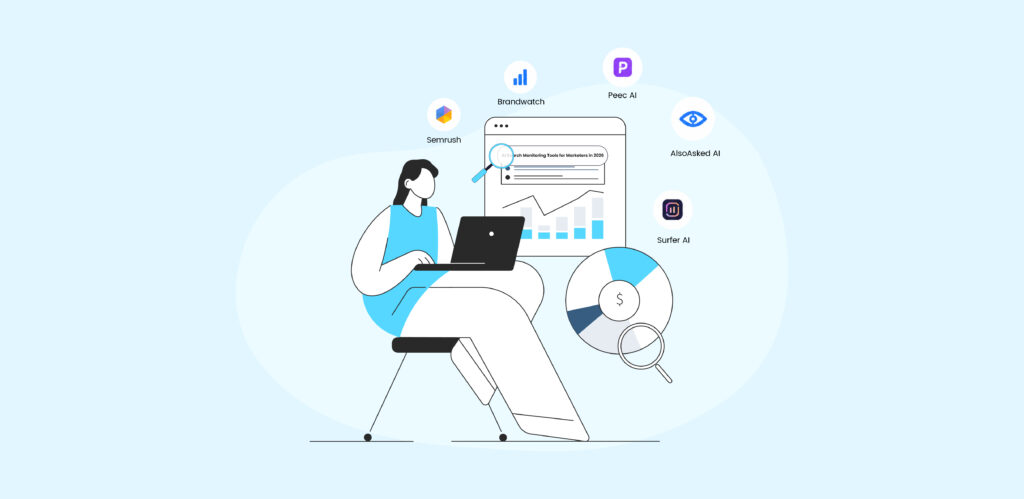
Now, with so many tools popping up, it can be hard to sift through the digital noise and pick one that best suits your needs. We’re breaking down the best AI search monitoring tools for marketers based on your needs and budget.
What is an AI Search Monitoring Tool?
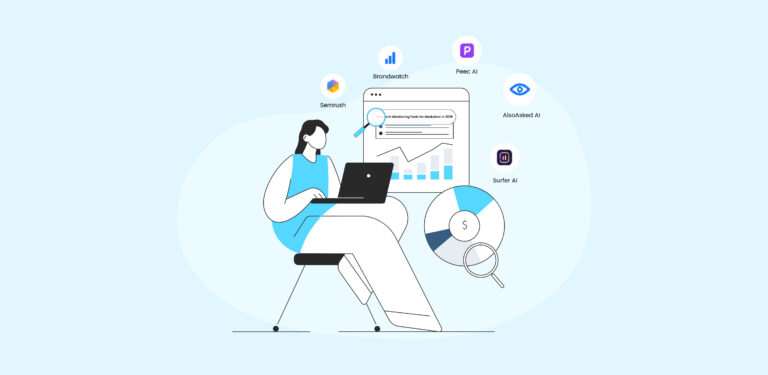
An AI search monitoring tool is quickly becoming a mandatory staple in every marketer’s tech stack because it tracks how your brand, competitors, products, pages, and sources appear across AI-generated answers, citations, and summaries.
An AI search monitoring tool tracks how your brand shows up inside AI-generated answers instead of inside a list of blue links.
Organic click-through rates dropped 61% on queries where an AI Overview appears, falling from 1.76% down to 0.61% based on Seer Interactive’s analysis of billions of search impressions.
Brands that actually get cited inside an AI Overview earn approximately 120% more organic clicks per impression than brands left out of the citation entirely, on the same query.
Some studies put that gap even higher. Brands cited inside an AI Overview see 35% more organic clicks and 91% more paid clicks than brands sitting in the traditional position one slot underneath it. That’s the entire argument for AI search monitoring tools for marketers in one data point. Ranking, being mentioned, and being cited are now separate visibility challenges.
Best AI Tools for AI Search Monitoring at a Glance
| Tool | Best For | Key Strengths |
| 1. Profound | Enterprise Brands & Agencies | Deep crawler-level data, multi-client governance, and narrative framing analytics. |
| 2. Frase | All-in-One Execution | Tracks prompt visibility and connects insights directly to an AI content drafting/refresh loop. |
| 3. Nightwatch | Hybrid SEO & LLM Tracking | Merges traditional SERP rank tracking with LLM prompt monitoring and citation sentiment. |
| 4. Peec AI | Specialist Analytics & High-Volume Prompts | Dedicated prompt clustering, share-of-voice metrics, and clean agency reporting. |
| 5. Otterly.AI | Lightweight & Budget-Friendly | Simple brand-mention alerts, affordable tiering, and basic GEO audits. |
| 6. Semrush AI Toolkit | Integrated SEO Stack | Adds an AI visibility layer to existing Semrush keyword and backlink workflows. |
| 7. MaxAEO / AEO Vision | Citation Actionability | Focuses heavily on reverse-engineering third-party citation sources (Reddit, listicles, niche sites). |
How We Evaluated These Tools
We compared these tools based on:
- Platform coverage
- Prompt tracking
- Citation-level reporting
- Competitor share of voice
- Sentiment analysis,
- Integrations, and
- Pricing accessibility.
Because AI search platforms change quickly, marketers should verify live feature coverage and pricing before choosing a tool.
How does an AI Search Monitoring Tool Work?
Most AI search monitoring tools run a set of prompts against LLMs and note the following 3 things:
1) whether you got mentioned
2) cited as a source
3) and the way these models describe you
But the best monitoring tools for marketers go beyond a simple yes-or-no. They also track sentiment, share of voice against competitors, and the specific URLs the model pulled from when it cited you.
However, the difference between AI search tracking and traditional rank tracking is that the latter assumes a stable, ordered list, whereas outputs from the former are not always certain. So, the same prompt may produce different answers across sessions, users, locations, and time.
Also, ranking well in organic search can help, but it does not guarantee citation. This is because language models and AI search systems evaluate different passages, sources, entities, and query expansions than a classic SERP, so the cited set can differ from the top organic results.
That’s why a forum thread with a genuinely useful answer can out-cite a page one Google ranking from a domain with a decade of authority behind it.
What AI Search Monitoring Tools Can’t Tell You
- They cannot guarantee citations.
- They cannot fully explain why an LLM chose one source over another.
- They can’t give a stable rank the way SERP trackers do.
- They may sample prompts differently, so data can vary by vendor.
- They may miss personalized, location-based, logged-in, or multimodal variations.
- They identify visibility gaps, but they do not fix content, authority, or trust signals by themselves.
What to Look For in an AI Search Monitoring Tool?
Before you commit your monthly marketing budget to a tool that claims to be an AI visibility platform, be wary of those that make big claims but don’t really have much to back it up.
Here is a detailed list of questions you should consider asking before investing in an AI search monitoring tool that really works for you.
Does it cover the platform your audience uses?
The top 5 platforms that matter the most for B2B and B2C categories are ChatGPT, Google AI Overviews, Perplexity, Gemini, and Copilot. Make sure the tool you choose offers bundles that include all five in a base plan. Some tools, like Ahrefs Brand Radar, will charge per platform, and that starts to add up if you want full coverage. However, research your target audience’s behavior to know where you’ll find them before you invest to reap the most benefits.
Does it provide depth of citation or just the mention count?
Anyone can build a tool that searches for your brand name in an AI response and logs a checkmark. The tools worth paying for tell you which specific page got cited, why the model picked that page over a competitor’s, and how that citation pattern shifts week over week. This matters even more given how concentrated citations already are. If YouTube and Wikipedia alone account for over 40% of all AI Overview citations, your monitoring tool needs to show you exactly where you fit against that concentration, not just whether your brand name appeared somewhere in the response.
How strong is the prompt set and sampling methodology?
A tool tracking 50 prompts a month is giving you noise, not a trend line. Ask any vendor how many prompts they sample and how often. This detail rarely shows up on the pricing page, and it’s the single biggest predictor of whether the data you’re paying for is defensible in a board meeting.
Does it offer accurate sentiment scoring?
Simply collecting citations like infinity stones isn’t the whole game. Quality of citations matters more than sheer quantity. Are you getting cited next to outdated pricing or with any kind of inaccurate information? If so, this is doing more harm than good, and this is the kind of information your dashboard needs to surface, not bury. Find a tool that gives you sentiment scoring that flags negative or inaccurate representations, not just a raw mention tally.
Does it have built-in competitive benchmarking?
You don’t just need to know if you’re showing up. You need to know if a competitor is showing up in your place on the same prompt. Share of voice against named competitors is what turns a monitoring tool into a strategic input instead of a novelty report.
How to Track Brand Mentions In LLMs?
Buying a tool is the easy part. Actually tracking brand mentions in LLMs in a way that produces a usable trend line takes a process, not a login.
Build a real prompt list, not just a list of keywords.
People don’t type “backlink software” into ChatGPT the way they’d type it into Google. They ask full questions: “What’s the best tool for finding backlink gaps between a competitor and me?” Your prompt set needs to mirror actual conversational queries, pulled from support tickets, sales calls, and Reddit threads in your niche. The average AI Mode search runs about three times longer than a traditional Google search, and more than one in six queries now include an image or other non-text input, which tells you conversational, specific prompts are the norm, not the exception.
Sample consistently across all the platforms
Tracking share of voice requires consistent query sampling across multiple AI platforms, since each system prioritizes different sources and shows its own citation patterns. You want to look for trends instead of getting a surface-level overview, so run your prompts every week.
Separate mentions from citations
Getting your name checked in a conversational answer is different from having your URL listed as a source. The latter drives referral traffic, and given that AI-referred traffic is converting well above typical Google organic traffic, that referral link is worth protecting and tracking closely.
Tie citation data back to your backlink profile
Language models are trained on and grounded by the same web that Google crawls, and a domain with a genuinely strong backlink profile is more likely to be treated as a credible source when a model is choosing what to cite live. Also, if competitors are cited more often, compare their content, linked sources, and branded mentions.
It’s just as important to audit how many links you need before you get any monitoring tool.
Best Tools to Monitor AI Overviews
AI Overviews work differently because they exist within the SERP and update very frequently. It’s grounded in live search results rather than pure model training data. AI Overviews now trigger on approximately 48% of all Google queries, approximately 88% for healthcare-related searches, and 83% for education.
SEO suite extensions like Ahrefs Brand Radar, Semrush AI Toolkit, and Conductor bolt AI tracking onto tools you already run. The upside is procurement simplicity and a workflow you already understand.
Profound, Otterly AI, and Peec AI win on citation depth and coverage across multiple platforms rather than Google alone. If Google AI Overviews are your primary concern and you already run Ahrefs or Semrush, start with the built-in add-on. If you need to understand AI Overviews alongside ChatGPT and Perplexity in one unified view, a dedicated specialist tool earns its separate line item.
A monitoring tool helps you identify the gaps. But you have to fix it using your content, technical SEO, digital PR, and link-building strategy. If ChatGPT and Google AI Overviews aren’t citing your site while zero-click behavior climbs toward 65% of all searches, the underlying issue usually traces back to authority signals that language models are still leaning on. Backlinks remain one of the strongest ones.